
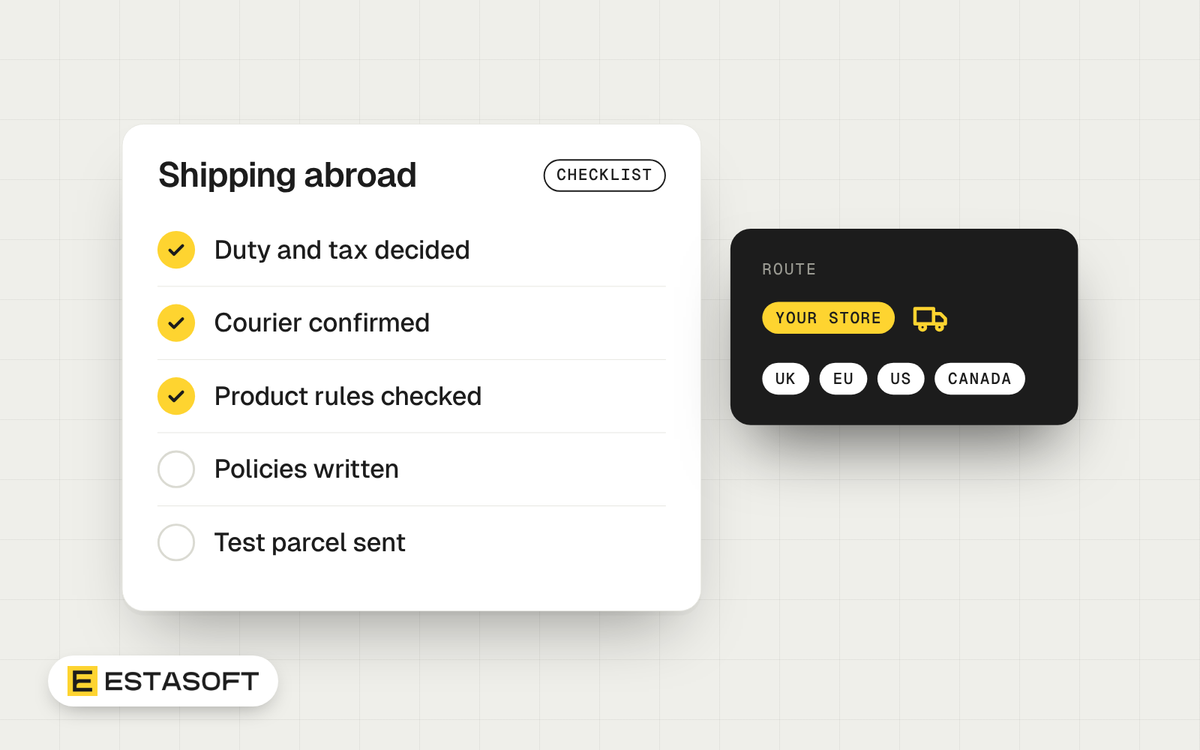
A store can take an order from anywhere. What changes when the customer is in London, Berlin, Texas or Ontario is everything after the click: tax, duty, delivery, returns and payment. This guide lists what to settle before you ship the first parcel to the UK, Europe, the US or Canada. It is written for brand owners and company owners in the Middle East.
It is general information, not legal or tax advice. These rules change, so we link the official pages and tell you the date we checked them: 30 October 2026. Check the links again before you decide.
1. Pick one destination first
Each country has its own rules. Start with the one where you already have customers or requests, learn its rules, and add the next one later. A single Shopify store can serve several countries, and our guide to Shopify Markets explains how.
2. Decide who pays duty and tax: you or the customer
There are two ways to handle import charges.
- Delivered duty paid. You collect duty and tax at checkout and pay them for the customer. Nothing is due at the door.
- Delivered duty unpaid. The customer pays the courier on delivery. Surprise bills are a common reason for refused parcels.
For most brands the first option is the better experience. It needs a courier that supports it and a way to work out the charges before the customer pays. Ask your courier first.
Shopify has a service called Managed Markets, where Global-e acts as the merchant of record and handles duties, import taxes and customs paperwork. Its help page says it is available to businesses based in the continental United States and to certain stores in Canada and the United Kingdom. It does not list stores in the Middle East, so plan to handle duty and tax yourself, through your courier or a specialist provider.
3. Check the rules in each destination
European Union
Since 1 July 2026 the EU charges a temporary customs duty of 3 euros per item on consumer parcels (distance sales) worth up to 150 euros. It runs until 1 July 2028, the planned start date of the EU customs data hub, and the Commission says it may be extended if that system is not ready. The seller or importer who declares the goods owes the duty; the Commission states that it is not a tax on consumers. An item means goods in the parcel that share the same tariff classification, description and, where relevant, origin. For example, five identical shirts count as one item, and a shirt and a watch count as two.
VAT is separate. The Commission's guidance names three routes: the Import One-Stop Shop (IOSS), special arrangements and the standard import procedure. We explain the change in our news post EU charges a 3 euro customs duty on small parcels. Read the Commission guidance and ask your courier how the duty will be declared and billed.
United Kingdom
For goods sold directly to customers in Great Britain in consignments of 135 pounds or less, GOV.UK says UK VAT is charged at the point of sale, and the seller must charge and account for it. In Northern Ireland, import VAT is charged instead. For consignments over 135 pounds, normal VAT and customs rules apply when the goods are imported. Read the page, or ask an adviser, to see whether you need to register for UK VAT.
United States
The United States suspended duty-free de minimis treatment for low-value shipments, which had covered goods worth 800 dollars or less, for all countries from 29 August 2025. See the presidential order and the CBP fact sheet. A trade report dated 25 February 2026 said a new executive order continued the suspension. Duties depend on the product and the country of origin, and they have been changing. Check with U.S. Customs and Border Protection and with your courier or broker before you ship.
Canada
The Canada Revenue Agency says the owner or importer of record pays GST or HST on imported goods, and that it is collected at the time of importation, together with any duty. Goods valued at 20 Canadian dollars or less sent by mail or courier to an address in Canada are non-taxable, with some exceptions. The Canada Border Services Agency explains how couriers account for duty and taxes on small shipments. Ask your courier how it handles Canadian shipments from your country.
4. Choose a courier and ask the right questions
- Can you deliver duty paid to this country?
- What documents do you need from me: a commercial invoice, product descriptions, tariff codes, values, country of origin?
- How long does delivery take, and is tracking included?
- What does it cost by weight and by country, and what is covered if the parcel is lost or damaged?
- How do returns work, and who pays for them?
In the shipping section of each product, Shopify lets you store the country of origin and a Harmonized System (HS) code. Fill them in before you ship abroad, because couriers and customs ask for them.
5. Check the product rules
Some goods face limits or extra rules by country: cosmetics, perfume, food, supplements, electronics, batteries and labeled textiles. In the EU, for example, the 3 euro duty also applies to products that were previously excluded from the exemption, such as alcohol, perfumes and tobacco, according to the Commission. Check the rules for your product type in each destination before you promise delivery.
6. Take payments your customers trust
Customers in the UK, Europe, the US and Canada expect to pay by card or wallet, and to see prices in their own currency. Shopify Payments is available only where your business is based. At the time of writing, its list of supported countries includes the United Arab Emirates but not Iraq or Saudi Arabia. If your business is elsewhere, you need another provider that accepts your business and your customers' cards. Shopify's help pages state that third-party transaction fees apply to payments processed through third-party gateways, so add that to your costings. Cash on delivery does not work for customers abroad. For the local options in Iraq and Kurdistan, read Taking online payments in Iraq and Kurdistan.
7. Write the policies for each market
- Delivery: how long it takes, what it costs and who pays duty and tax.
- Returns: the time allowed, who pays the return shipping, and where to send the parcel.
- Privacy and cookies: customers in the UK, the EU, the US and Canada fall under different rules. See Privacy and cookies for a Shopify store.
- Consumer rights: rules such as the right to return a distance purchase differ by country. Ask an adviser who knows each market.
- Accessibility: the European Accessibility Act has applied to online stores that sell to EU consumers since 28 June 2025. See European Accessibility Act for online stores.
8. Send a test parcel
Before you advertise, send one real order to a friend or partner in the destination country. Measure the delivery time, the full cost, any charge asked at the door, the condition of the packaging and the tracking updates. Fix what you find, then send a second one.
Questions store owners ask
Can one store sell to several countries?
Yes. Shopify Markets lets one store show different currencies, languages and prices to customers in different countries. Separate stores are a choice for cases such as separate companies or separate stock.
Do I need a company in the destination country?
It depends on the country, the value you sell and the type of goods. Ask an accountant who knows that market. Managed Markets is one way some merchants avoid registering abroad, but Shopify's help page does not list stores based in the Middle East as eligible.
Should I add the 3 euro duty to my prices?
You can build it into the price or show it as a charge at checkout. Either way, decide before launch, so the customer sees the full cost before paying and not at the door.
Need a hand?
We build Shopify and eCommerce stores for clients in Kurdistan, Iraq, the UAE and the UK. If you plan to sell in more countries, read about our eCommerce solutions or send a short brief on the contact page.