
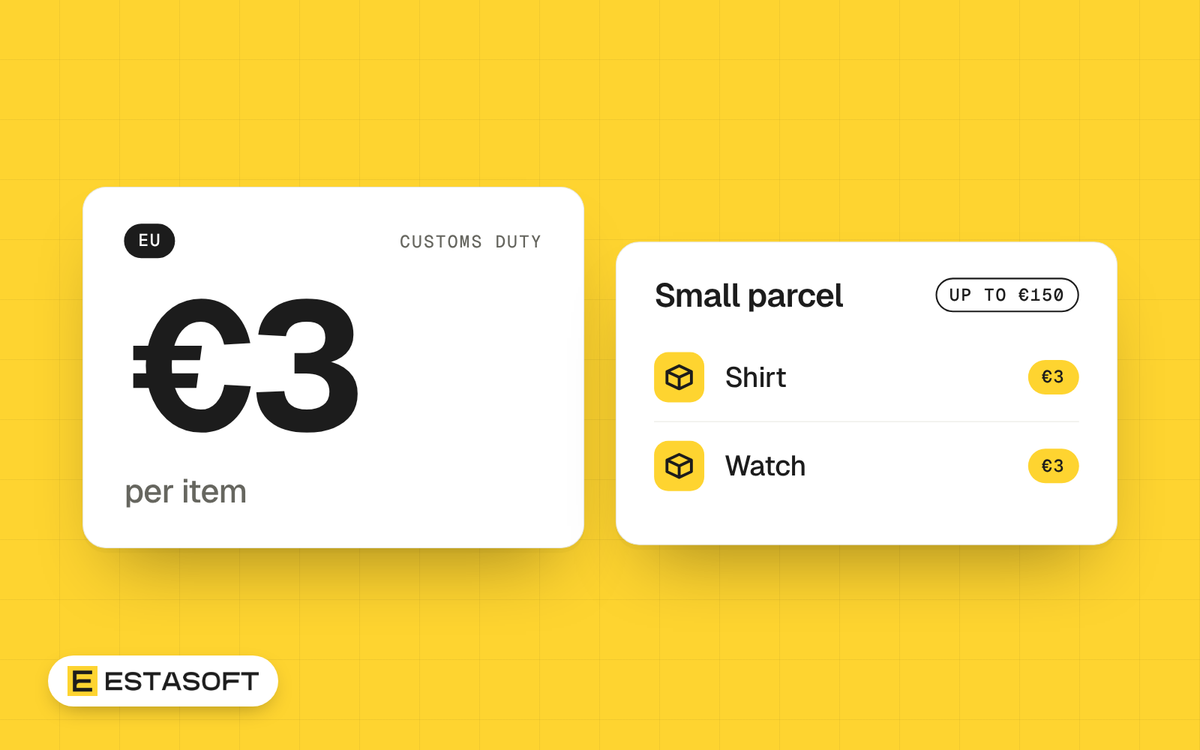
Since 1 July 2026, the European Union charges a flat customs duty of €3 per item on consumer parcels worth up to €150 that arrive from outside the EU. It replaces the duty relief that applied to low-value parcels until 30 June 2026. If you sell to customers in the EU from outside it, including from the Middle East, this changes what a parcel costs to deliver. This post was published on 30 October 2026.
What changed
- Start date and length. The duty applies from 1 July 2026 to 1 July 2028 and may be extended. The Council says it will be replaced by normal customs tariffs once the new EU customs data hub is working, which it expects in 2028.
- Amount. €3 on each different category of item in a parcel. In the Council's example, a parcel with goods under two tariff sub-headings pays €6. The Commission gives a similar example: five T-shirts are one item and cost €3, while one T-shirt and one watch are two items and cost €6.
- Which parcels. Consignments worth €150 or less that are distance sales of imported goods to consumers, whichever VAT scheme is used. The duty also applies to products that were previously excluded from the exemption, such as alcohol, perfumes and tobacco.
- Who owes it. The declarant: the seller or importer, including a seller registered for the Import One-Stop Shop (IOSS), or their representative. The Commission states that the duty is not a tax on consumers.
- Legal basis. Council Regulation (EU) 2026/382.
What it means for your store
- If you ship from outside the EU to consumers in the EU, work out the duty for a normal order: the number of different product categories in the parcel multiplied by €3.
- Decide whether to include it in the product price or to show it as a charge at checkout. Showing the full cost before payment avoids refused parcels.
- VAT is a separate matter. The Commission's guidance names three routes: IOSS, special arrangements and the standard import procedure.
- Ask your courier or customs broker how the duty will be declared and billed, and who they will charge.
- Product identifiers become mandatory from 1 November 2026, to improve traceability and safety checks. Ask your courier what information it needs from you.
- The Commission also mentions a proposed separate Union handling fee. Its amount and date of application, in autumn 2026, are still to be decided.
For the wider checklist, including the UK, the US and Canada, read Selling from the Middle East to the UK, Europe, the US and Canada. If one store has to serve several countries, see Shopify Markets: how to sell in several countries from one store. This post is general information, not legal or tax advice.
Sources
- European Commission: guidance and legal text on the temporary flat fee on low-value imports
- European Commission, Access2Markets: EU applies €3 customs duty per item on low-value e-commerce consignments
- Council of the EU: final green light to new customs duty rules for small parcels, 11 February 2026
- EUR-Lex: Council Regulation (EU) 2026/382
Need help with an international store? Read about our eCommerce solutions or send a short brief on the contact page.