
Online payment is the question we hear most from store owners in Iraq and Kurdistan. The honest answer is that there is no single solution, and the options change. This guide explains the choices you have today and gives you questions to ask before you pick one.
Start with what is not available
Shopify's own card service, Shopify Payments, is not offered to businesses in Iraq. Iraq is not on Shopify's list of supported countries, which does include the United Arab Emirates. So a store in Iraq needs another way to get paid. Check the current list before you plan, because it changes.
Option 1: cash on delivery
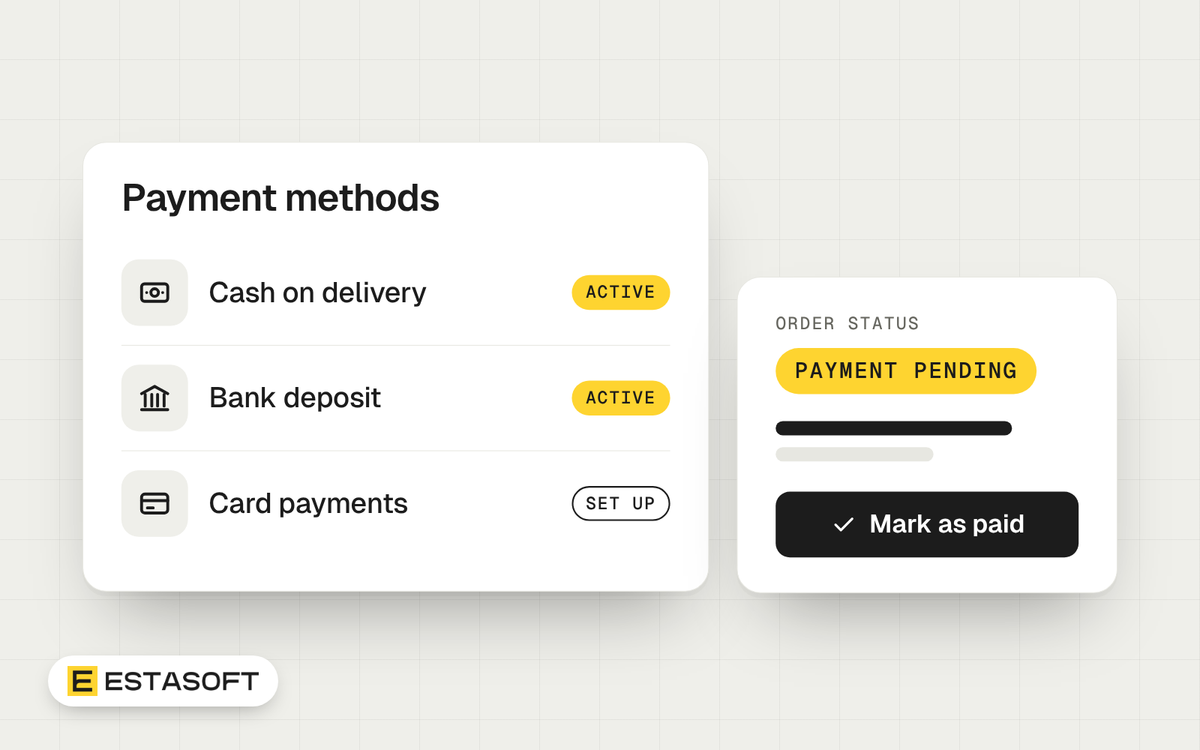
Cash on delivery is one of Shopify's manual payment methods. The customer places the order, and your courier collects the money at the door. Shopify marks these orders as unpaid, and you mark them as paid after the money arrives. You are not charged third-party transaction fees for manual methods. This is the simplest way to start, and many customers in the region still prefer it. An overview of fintech in Iraq published in May 2023 quoted one Iraqi marketplace saying that only about 2 percent of its transactions were paid online, with most customers choosing cash on delivery. Treat that as one marketplace at one moment, but it shows why cash must be part of your plan.
The weak point is orders that are refused or not answered at the door. Confirm orders by phone or message before they ship, and think about asking for a small deposit on large or custom orders.
Option 2: bank or wallet transfer
The customer pays by transfer, and you confirm the payment before shipping. In Shopify this is also a manual payment method, and the payment instructions appear on the order confirmation page. It costs nothing to set up. The cost is your team's time to check each payment, and a delay before the order can ship.
Option 3: a local online payment provider
Several Iraqi companies offer online payments. The same fintech overview names, among others:
- Wayl: a payment service for small merchants, with payment links and a developer kit.
- NassPay and Nasswallet: online payments and a mobile wallet.
- PelePare: described as the first established digital payment service in the Kurdistan Region.
- FastPay: payments from a mobile phone.
- ZainCash and Asiahawala: wallets run by mobile operators.
- QiCard and Blue Pay: card and payment services.
We name them so you know what exists, not to recommend one. Services open, change and close, and being on a list does not mean a provider works with a Shopify checkout today. Ask each one directly.
Questions to ask any provider
- Do you accept my type of business and my registration?
- Do you work with Shopify checkout, through an app or a payment integration, today?
- Which currencies do you support, dinar, dollar or both?
- What are the fees, and how long until I receive the money?
- How do refunds work?
- Who answers when a payment goes wrong, and in which language?
The provider approves your account, not your developer and not Shopify. Apply early, because approval can take time.
Decide the currency question
The same overview describes merchants who accept only one currency while the customer holds the other. Decide which currency you price in and how you handle customers who want to pay in the other. Keep the rule simple, and write it on the store.
A sensible plan to start
- Open with cash on delivery and, if you can check them, bank or wallet transfers.
- Apply to one or two local providers while the store is being built.
- Add the online option that works for your business when it is approved and tested.
- Review after a few months, using your own orders to see what customers choose.
Test every method with a real order before you launch. Our eCommerce solutions include setting up the payment providers available in your country. If you want help choosing, send a short brief on the contact page. For the wider picture of a first launch, read How to launch an online store in the Middle East.