
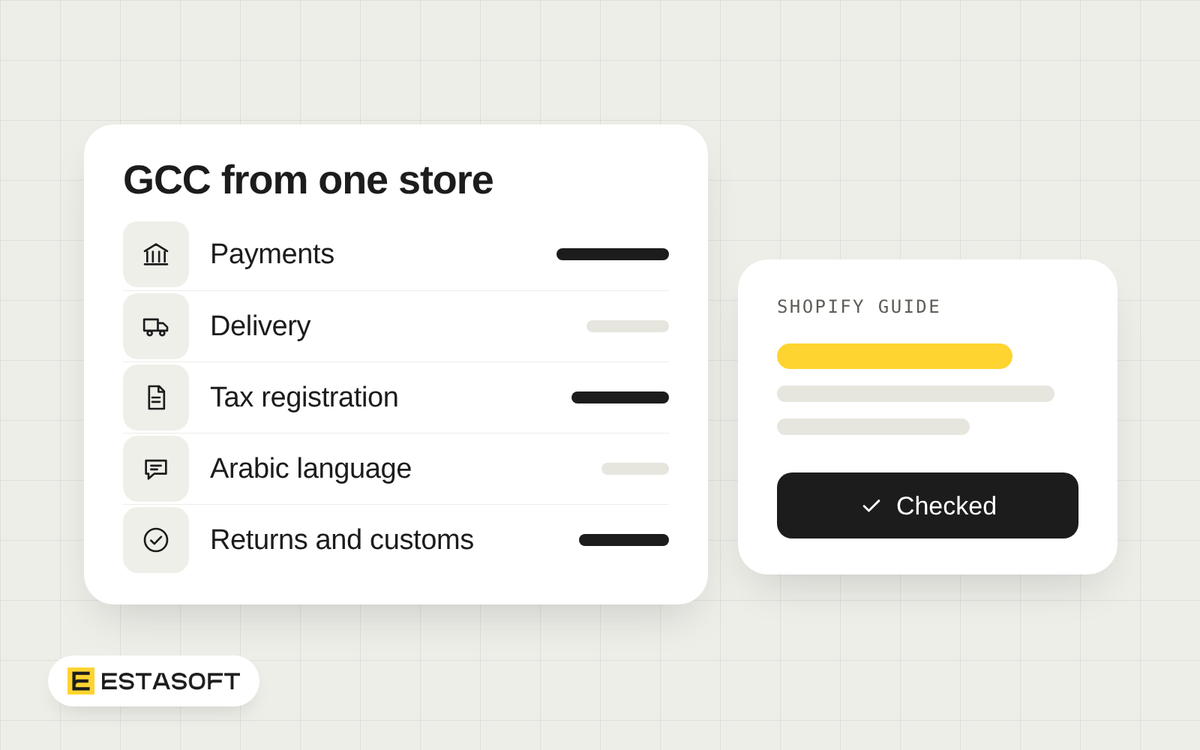
On a map the Gulf looks like one market. Six countries sit side by side, share a customs area and have many online shoppers. One Shopify store can serve all of them. But your payment provider, your couriers, your tax adviser and your customers still treat the six countries as six separate places.
This guide gives you a way to decide which country to open first and which to add next. It uses six tests and a scoring grid, with the facts we could confirm from official and vendor pages on 3 November 2026. It does not rank the countries, because the right order depends on where your company is registered, where your stock sits and what you sell. The set-up steps are in our guide to Shopify Markets. Rates and duty are in selling to the UAE and Saudi Arabia.
What the six countries share, and what they do not
They share a customs union. A page on the UAE government site icp.gov.ae says a common external tariff of 5 percent applies to goods from outside the union, that duty is collected at the first customs point of entry, and that goods move between member states without customs restrictions. It dates the union from 1 January 2003 and shows 28 March 2024 as its last update. Ask a customs broker whether your products carry a different rate.
They also share a tax agreement. The GCC VAT agreement, which ZATCA hosts on its site, names all six states as members. A shared agreement does not give you shared rules today, as the tax test below shows. Do not assume payment methods, delivery networks and consumer rules are shared either.
How the scoring works
Give each country one mark per test: ready, needs work or unknown. Mark a country "ready" only when the person who knows has given you a written answer. That person is your payment provider, your courier or your adviser, depending on the test. Unknown is a risk, not a pass.
Payments: can customers pay the way they expect?
Start with the platform. Shopify's list of countries for Shopify Payments has 41 entries. Of the six Gulf countries, only the United Arab Emirates is on it. Shopify's separate page on payout currencies, which we also read, does not list the UAE dirham, so confirm with Shopify before you plan around Shopify Payments there. Shopify says that if your country is not listed you need a third-party payment provider. So a store run from Saudi Arabia, Kuwait, Bahrain, Oman or Qatar starts with a third-party provider. Connecting one is checkout work for whoever builds your Shopify store.
That choice reaches into currency. Shopify says a store needs Shopify Payments or Adyen to take payments in several currencies. With other providers, customers in every market pay in the store's default currency. A store with a third-party provider that opens six markets therefore shows one currency to all six. Decide early whether your customers will accept that. The Shopify pages we read do not list which Gulf currencies Shopify Payments supports, so ask Shopify or your provider for the exact list.
Then look at local card schemes. The Saudi Central Bank (SAMA) says it owns mada and that mada cards can pay online through 3D Secure. KNET, in Kuwait, says its gateway lets merchants collect online payments from bank debit cards. It also says a merchant joins by signing a contract with a local member bank. The lesson is practical: some local methods come through a bank in that country. BENEFIT describes BenefitPay in Bahrain as an app for paying and transferring money, with an option to pay online, but we found no official page that tells a foreign store how to connect. We found none for Qatar or Oman. Ask your provider which local methods it supports in each country.
Cash on delivery is a separate question. Shopify supports it as a manual payment method. The order shows as unpaid until you mark it paid, and Shopify says it charges no third-party transaction fee on manual methods. Whether it works in a country depends on your courier. Ask whether it collects cash there and how the money reaches you.
Delivery: can your courier reach the door and take the parcel back?
Shopify asks you to set shipping rates for every country you want to sell to, and a country must be in an active market before customers there can check out. Each shipping zone can have its own rates. Shopify's rates page names built-in carrier options for fulfilment locations in the US, Canada, the UK, Italy, Germany and Spain, and none for a Gulf location. For the Gulf, expect to set your own rates or to connect your courier through the courier's own tools. For each country, ask the courier in writing:
- How many days does delivery take, and what does a standard parcel cost?
- Does the courier collect cash, and when does the money reach you?
- Who collects a return, and at what cost?
- What happens to a parcel nobody accepts?
Customs and stock: where does the duty fall?
Where your stock sits changes the answer. If goods enter the GCC from outside, the UAE government page says duty is collected at the first point of entry. Ask your courier or customs broker how a parcel crosses each border from your stock location. Shopify lets you show duties and import taxes as a separate line at checkout, or include them in your prices. Its page does not list the countries where this works, so ask before you rely on it.
Tax registration: what does selling there make you do?
This is what the pages said on 3 November 2026. Rules and thresholds can change.
- Saudi Arabia. A ZATCA guideline (September 2022) says a non-resident that is not registered must register if it is liable for VAT on supplies made or received in the Kingdom, whatever the value. A second guideline (May 2026) gives 15 percent as the standard rate and says the importer pays import VAT, due at customs clearance, with a return-based route if approved.
- United Arab Emirates. The Federal Tax Authority shows a mandatory registration threshold of AED 375,000 and a voluntary one of AED 187,500. The page says the mandatory threshold does not apply to foreign businesses. Ask an adviser what that means for you.
- Bahrain. The National Bureau for Revenue says a non-resident that supplies people who are not registered for VAT must register within 30 days of its first taxable supply, whatever its turnover.
- Oman. According to the Oman Observer in September 2022, reporting Oman Tax Authority guidance, an online supplier with no residence in Oman must register if the law requires it to collect VAT on sales there. The article is four years old, so check the authority's current pages.
- Qatar. The General Tax Authority's investors guide says Qatar has not applied VAT. The page is undated.
- Kuwait. According to the audit firm Baker Tilly Kuwait (page undated), VAT has not been implemented and no official date is set. We could not open an official Kuwaiti page.
Each country with VAT adds registration, filing and invoice work. Saudi Arabia adds e-invoicing: ZATCA's roll-out page says phase one applied from 4 December 2021 to all taxpayers except non-residents, and phase two is enforceable from 1 January 2023 in waves, with at least six months' notice. Waves and dates can change. Ask your adviser whether registering there would bring those duties to you. Our Saudi Arabia guide covers the store rules.
Language: one Arabic version or several?
Shopify lists Arabic among the languages with checkout translations and default content for themes it builds. For right-to-left layout it names its Horizon-family themes and tells you to confirm support in any other theme. In Markets you can set a language, and a domain or subfolder, for each market. So you can start with one Arabic version and split it later if customers in one country find the wording foreign. Test with real customers before you split. Read Arabic and English on one store for the set-up. Also test your checkout form: does the phone field accept each country's numbers?
Returns: which rules apply to the order?
We confirmed one country. The Saudi E-Commerce Law (Royal Decree M/126, 10 July 2019, English text hosted on misa.gov.sa) lets a consumer cancel within seven days of receiving an unused product, with exceptions (Article 13). It also lets a consumer cancel and claim a refund if delivery runs more than 15 days past the contract date, unless the parties agreed otherwise or force majeure applies (Article 14). The text is a translation and may not show later changes. We did not open an official consumer law for the other five countries, so ask a local adviser. Check that your courier has a return route before you promise returns in a country.
Score the countries and pick an order
Draw a grid with the six tests down the side and the six countries across the top. Fill every cell with ready, needs work or unknown. Then apply two rules:
- Open first the country with the most ready cells. If two tie, pick the one where your company is registered or your stock sits.
- Add next the country that reuses the most answers from the first: the same payment provider, courier, currency and adviser.
Two made-up examples show how the grid changes the answer. A brand registered in the UAE is on Shopify's list for Shopify Payments, so it can check that option first. Adding Saudi Arabia then brings a registration question, Arabic invoice rules and a mada check. A brand registered in Kuwait starts with a third-party provider and, if it takes KNET, a contract with a local bank. According to Baker Tilly Kuwait its home market has no VAT, so adding Saudi Arabia brings registration and invoice rules that home sales never needed. Your own grid decides.
Gates before you open the next country
Run the first country long enough to learn from real orders. Then check four things before you add another:
- Payments settle correctly, and you know how many fail at checkout.
- Deliveries arrive when promised, and returns come back.
- Your adviser confirms what has been filed and what is due.
- Arabic-speaking customers can ask for help and get an answer.
This is general information, not legal or tax advice. Check the current rules or ask a qualified adviser before you decide.
Need a hand?
ESTASOFT has offices in Dubai, Erbil and London. For the store side of a multi-country launch, see our Shopify solutions page, or send a short brief on the contact page. If smaller markets come next, our guides to Qatar and Bahrain and Oman cover them.
Sources
- Shopify Help Center: supported countries for Shopify Payments: The list of 41 countries, only the UAE among the six Gulf states, and the advice to use a third-party provider if a country is not listed (page undated) (checked 3 November 2026)
- Shopify Help Center: supported payout currencies: The page lists no Gulf currency and not the UAE, which differs from the supported countries page (page undated) (checked 3 November 2026)
- Shopify Help Center: local currencies: Shopify Payments or Adyen needed to take payments in several currencies; other providers mean the default currency in every market (page undated) (checked 3 November 2026)
- Shopify Help Center: requirements and considerations for Markets: Shipping rates needed for every country; only customers in active markets can check out (page undated) (checked 3 November 2026)
- Shopify Help Center: Markets overview: Domain, subfolder and language settings for each market (page undated) (checked 3 November 2026)
- Shopify Help Center: duties and taxes by market: Duties and import taxes can be collected at checkout; no list of countries on the page (page undated) (checked 3 November 2026)
- Shopify Help Center: setting up shipping rates: Built-in carrier options listed for the US, Canada, the UK, Italy, Germany and Spain (page undated) (checked 3 November 2026)
- Shopify Help Center: shipping zones: Zones group countries and each zone has its own rates; fixed local currency rates need Shopify Payments (page undated) (checked 3 November 2026)
- Shopify Help Center: manual payment methods: Manual methods such as cash on delivery: order shows as unpaid until marked paid; no third-party fee (page undated) (checked 3 November 2026)
- Shopify Help Center: pricing overview: No third-party transaction fee on manual methods such as cash on delivery (page undated) (checked 3 November 2026)
- Shopify Help Center: requirements for selling in multiple languages: Arabic among the languages with checkout translations; Horizon-family themes for right-to-left; confirm support in other themes (page undated) (checked 3 November 2026)
- UAE government site: customs union for GCC states: Common external tariff of 5 percent, duty collected at the first point of entry, free movement between member states, in effect from 1 January 2003; page shows 28 March 2024 as last update (publisher not named on the page) (checked 3 November 2026)
- GCC VAT agreement (PDF hosted by ZATCA): The agreement names all six GCC states as members (checked 3 November 2026)
- ZATCA: VAT guideline for electronic contracts (version 1, September 2022): Section 7.1.3: a non-resident not registered for VAT must register if liable to pay VAT on supplies made or received in the Kingdom, regardless of value (checked 3 November 2026)
- ZATCA: guideline on imports and exports under VAT provisions (second edition, May 2026): Standard rate of 15 percent; the importer pays import VAT, due at customs clearance, with a return-based route if approved (checked 3 November 2026)
- ZATCA: e-invoicing roll-out phases: Phase one from 4 December 2021 (excluding non-resident taxpayers); phase two enforceable from 1 January 2023 in waves with at least six months notice (checked 3 November 2026)
- Federal Tax Authority (UAE): registration for VAT: Thresholds of AED 375,000 and AED 187,500, and the statement that the mandatory threshold is not applicable to foreign businesses (checked 3 November 2026)
- National Bureau for Revenue (Bahrain): VAT registration: Non-residents supplying unregistered persons register within 30 days of the first taxable supply (Arabic page, read in translation) (checked 3 November 2026)
- Oman Observer: e-commerce subject to VAT in Oman (3 September 2022): News report of Oman Tax Authority guidance on VAT registration for online suppliers without residence in Oman (secondary source) (checked 3 November 2026)
- General Tax Authority (Qatar): investors guide: Statement that Qatar has not applied VAT (page undated) (checked 3 November 2026)
- Baker Tilly Kuwait: value added tax services: Statement by an audit firm that VAT has not been implemented in Kuwait and no official date is set (secondary source, undated) (checked 3 November 2026)
- Saudi Central Bank (SAMA): mada: mada owned by SAMA; mada cards can pay online through 3D Secure (checked 3 November 2026)
- KNET: payment gateway: Gateway for online payments from bank debit cards; a merchant joins through a contract with a local member bank (checked 3 November 2026)
- BENEFIT (Bahrain): BenefitPay: BenefitPay described as a payment app with an option to pay online (checked 3 November 2026)
- Saudi E-Commerce Law, Royal Decree M/126 (English text hosted on misa.gov.sa): Articles 13 and 14 on seven day cancellation and late delivery; English text hosted on misa.gov.sa, a translation that may not show later changes (checked 3 November 2026)