
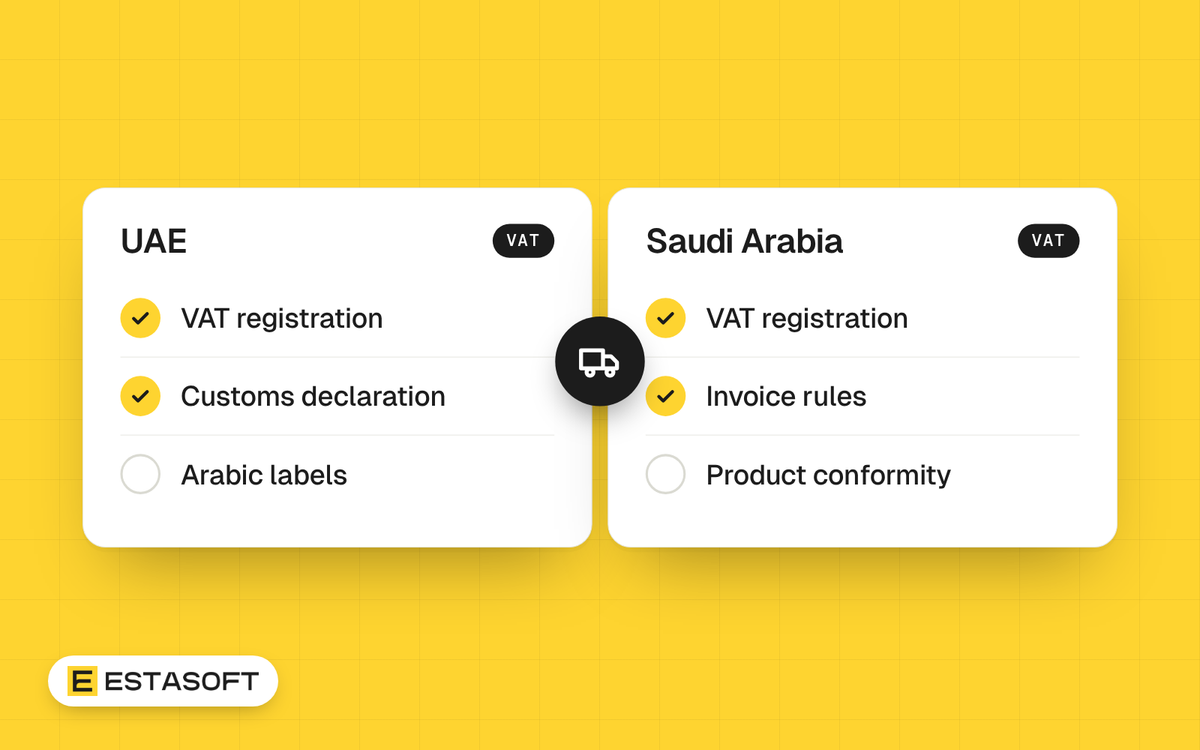
Selling to the UAE and Saudi Arabia from outside the Gulf raises the same questions. Do you register for VAT? Who pays customs duty? What must the invoice and the label say? This guide answers them with figures from official pages opened on 30 October 2026, and it names the source for each.
It is for owners and managers of online brands about to ship to either country. This is general information, not legal, tax or professional advice, so check each point with a qualified adviser for your country and products.
UAE VAT: rate, thresholds and foreign sellers
At the time of writing (30 October 2026), the UAE Ministry of Finance gives the standard VAT rate as 5 percent, in force since 1 January 2018. The Federal Tax Authority (FTA) sets mandatory registration at AED 375,000 of taxable supplies and imports, and voluntary registration for UAE-resident businesses from AED 187,500. Both tests look at the past 12 months or at what you expect to reach in the next 30 days.
The mandatory threshold does not apply to foreign businesses. The FTA says a business based outside the UAE must register if it makes taxable supplies in the UAE, whatever their value, unless another party in the UAE is responsible for settling the VAT on them. You must apply within 30 days of being required to register, and a late application brings a penalty.
The FTA says the place of supply of goods is generally their location when the supply takes place. For goods bought from abroad, VAT is due on the import: a VAT-registered buyer uses the reverse charge, and an unregistered buyer must pay before the goods are released. Whether your sale is a UAE supply or your customer's import depends on how you ship, so settle it with an adviser.
Saudi VAT: 15 percent and Arabic invoices
ZATCA, the Zakat, Tax and Customs Authority, states a standard VAT rate of 15 percent in its guidelines. Its imports guideline (second edition, May 2026) sets mandatory registration at SAR 375,000 of taxable supplies over 12 months and voluntary registration for residents at SAR 187,500 of taxable supplies or expenses. The thresholds match the UAE's, but the rate does not.
For foreign sellers, the imports guideline says a non-resident who must pay VAT in the Kingdom must register whatever the value of its supplies. The Implementing Regulations give a non-resident who owes tax 30 days from the first supply to apply.
ZATCA's tax invoicing guideline says invoices must be issued in Arabic. A second language is allowed but counts only as a translation, and an invoice without the required Arabic information is not a valid tax invoice.
Customs duty and import charges
Both countries apply the GCC common external tariff to most goods from outside the bloc. The UAE government portal states the duty as 5 percent of the goods value plus cost, freight and insurance. For Saudi Arabia, the US International Trade Administration (page published 11 May 2026) says the rate is at least 5 percent for most goods, charged on the CIF value.
Low-value parcels
There is no single Gulf rule. Dubai Customs Notice 16/2026, issued on 30 July 2026 and effective from 3 August 2026, exempts goods worth up to AED 1,000 from customs duties. A Dubai Customs news item of 4 September 2026 describes it as a rise for e-commerce shipments from AED 300 to AED 1,000 of CIF value. The exemption excludes tobacco, electronic smoking devices, nicotine liquids, alcoholic beverages and food preparations containing alcohol. The notice amends Dubai's cross-border e-commerce procedures and has Dubai Customs register the companies that use them, so ask your courier whether your parcels qualify. It covers duty, not VAT.
For Saudi Arabia the pages opened show a fee, not a duty-free limit. From 6 October 2024 ZATCA charges customs service fees of 0.15 percent of the goods value, with a minimum of SAR 15 and a maximum of SAR 500. Individuals' shipments from online stores worth SAR 1,000 or less pay a flat SAR 15 declaration fee. Import VAT is paid by the importer to ZATCA with duties and other fees, as a condition of clearance.
E-invoicing: where each country stands
Saudi Arabia. The generation phase began on 4 December 2021. The integration phase, which connects your system to ZATCA's Fatoora platform, runs in waves from 1 January 2023. Wave 25, published on 24 July 2026, covers taxpayers whose VAT-subject revenue exceeded SAR 187,500 in any of 2022 to 2025. ZATCA notifies the taxpayers it targets, and the integration deadline is 1 February 2027. ZATCA's guideline says taxable persons who are not residents in the Kingdom are not required to issue electronic invoices.
UAE. The Ministry of Finance guidelines (version 2.0, dated 26 October 2026) say e-invoicing is mandatory for any person conducting business in the UAE, VAT-registered or not. Supplies to or from individuals who are not in business are outside scope, so a plain consumer sale is not covered, but sales to other businesses may be. For businesses with annual revenue of AED 50 million or more, the last date to appoint an accredited service provider is 30 October 2026, the day this article was checked, and the last date to implement is 1 January 2027. Below that revenue, the dates are 31 March 2027 for the provider and 1 July 2027 to implement. A May 2026 Ministry news item shows the provider date moved from 31 July 2026.
Product conformity and labels
SASO's 2018 announcement describes its SABER e-platform as the place to register and issue conformity certificates for consumer products before they enter the Saudi market. The International Trade Administration (page changed 1 October 2024) calls SABER mandatory for imported goods and says the importer starts the process, with a certificate of conformity for regulated products, a requester declaration for unregulated ones, and a shipment certificate before customs. That page also describes events from 2018, so confirm current rules with SASO.
In the UAE, the Ministry of Industry and Advanced Technology (MOIAT) issues conformity certificates for regulated products under its ECAS service. The pages opened do not list those products, so ask MOIAT or your broker.
Plan for Arabic on labels. The International Trade Administration's UAE page (published 25 August 2025) says its labeling rules apply to regulated products, that labels must be in Arabic only or in Arabic and English, and that Arabic stickers need UAE approval and must be applied before export. Its Saudi page (published 11 May 2026) says warnings, safety instructions and manuals must be in Arabic or in Arabic and English, and that country of origin must be shown on imported goods.
Delivery and addresses
Dubai Municipality describes Makani as a 10-digit number for a building entrance, accurate to about 1 meter. Saudi Post describes the Saudi short address as 4 letters and 4 numbers. A checkout with two free-text address lines loses these. See also Arabic and English on one store and selling from the Middle East to the UK, Europe, the US and Canada.
Checklist for your first Gulf order
- Decide your model: ship from abroad, or hold stock in the UAE or Saudi Arabia. Ask your adviser how VAT applies.
- Track 12-month sales to each country against AED 375,000 and SAR 375,000. The window to apply is 30 days.
- Get a tariff code for each product from your broker and check charges with your courier.
- Check whether each product needs a SABER or MOIAT conformity certificate.
- If you are VAT-registered in Saudi Arabia, issue invoices with the required Arabic information.
- Check labels and manuals for Arabic and country of origin, and add any stickers before export.
- Add checkout fields for a Makani number or Saudi short address, and a phone number.
- Say at checkout who pays duty and VAT. On Shopify, see our article on selling in several countries with Shopify Markets.
- Send one test parcel to each country before a campaign and keep the customs paperwork.
Questions for your customs broker or courier
- Who is the importer of record for a parcel sent to a consumer, and who pays duty and import VAT?
- Which tariff code and duty rate apply to each product?
- Does the Dubai Customs AED 1,000 exemption apply to my parcels, and what applies in other emirates?
- Are duties and VAT collected before or on delivery, and what happens if the customer refuses the parcel?
- For goods shipped from the UAE to Saudi Arabia, what proof of duty already paid will Saudi customs accept?
Mistakes to avoid
- Treating the two countries as one tax area. VAT is 5 percent in one and 15 percent in the other.
- Assuming a small parcel pays nothing. The AED 1,000 rule is a Dubai Customs rule on duty only, and Saudi Arabia charges a flat declaration fee.
- Not tracking sales against the thresholds, then missing the 30 day window to apply.
- Issuing English-only invoices once you are registered in Saudi Arabia.
- Planning on dates from an old guide. The UAE provider deadline has already moved once in 2026.
Questions owners ask
Do I need to register for VAT if I sell from abroad?
Both authorities say a non-resident who must pay VAT in the country must register, whatever the value. The UAE has an exception where another UAE party settles the VAT. Whether your sales count as supplies there depends on where the goods are and who imports them, so get written advice first.
Do I have to issue e-invoices?
In Saudi Arabia, ZATCA's guideline says non-resident taxable persons are not required to issue electronic invoices. In the UAE, consumer sales are outside scope, but sales to businesses may be in scope from the dates above.
Is there a duty-free limit for small parcels?
Dubai Customs exempts e-commerce goods up to AED 1,000 from duty under its 2026 notice, with listed exclusions. The Saudi pages opened show a SAR 15 fee for online-store shipments up to SAR 1,000, not a duty-free limit. VAT is separate in both countries.
Need a hand?
ESTASOFT works with clients in Kurdistan, Iraq, the UAE and the UK. We cannot give tax or customs advice, but we can help with the store side: markets, checkout, payments and shipping. See our eCommerce solutions, ask for the free store review, or send a short brief on the contact page.
Sources
- UAE Ministry of Finance: VAT
- Federal Tax Authority: VAT registration service
- Federal Tax Authority: FAQs
- UAE Government portal: Customs duty
- UAE ICP: Customs union for GCC states
- Dubai Customs: Customs Notice No. (16/2026)
- Dubai Customs: news of 4 September 2026
- UAE Ministry of Finance: Electronic Invoicing Guidelines
- UAE Ministry of Finance: eInvoicing amendments
- MOIAT: Issue Conformity Certificates for Regulated Products
- Dubai Municipality: Makani
- ZATCA: Imports and exports under VAT guideline
- ZATCA: Tax invoicing and records guideline
- ZATCA: Implementing Regulations of the VAT Law
- ZATCA: Detailed guidelines for e-invoicing
- ZATCA: Wave 25 of e-invoicing
- ZATCA: Customs service fees
- International Trade Administration: Saudi import tariffs
- International Trade Administration: Saudi testing, inspection and certification
- SASO: Saber e-platform announcement
- International Trade Administration: UAE labeling and marking
- International Trade Administration: Saudi labeling and marking
- Saudi Post: National Address