
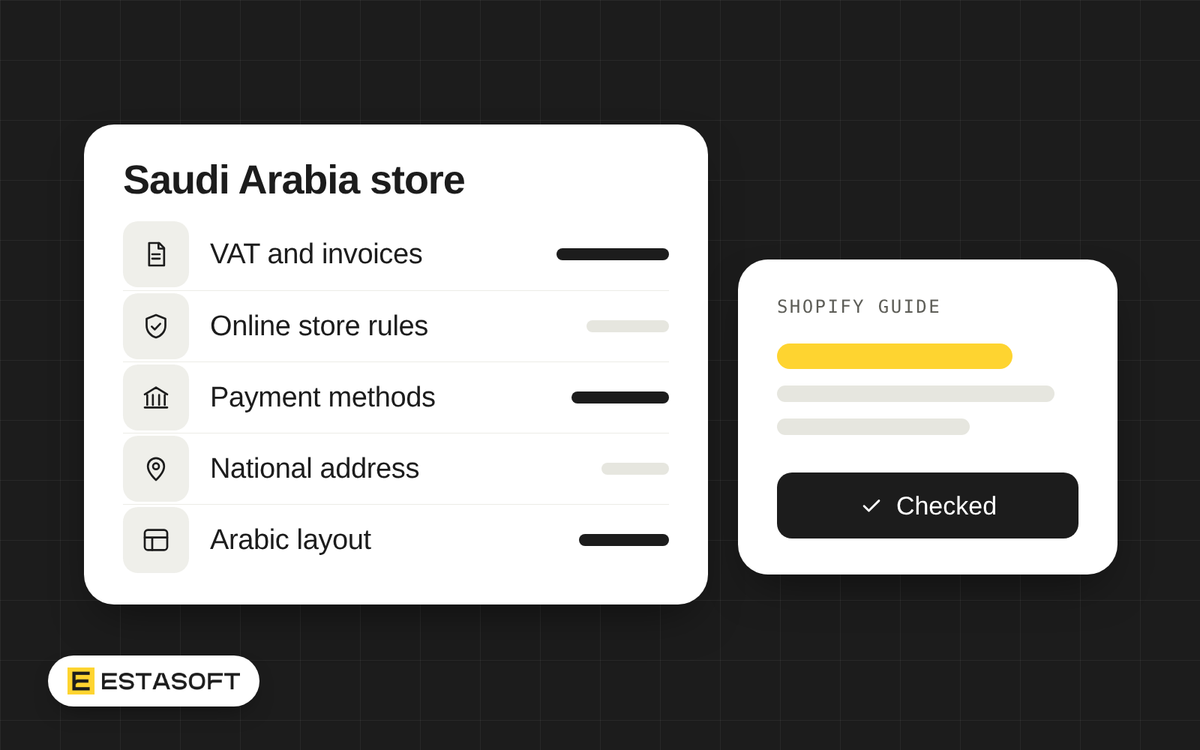
A store built for Saudi customers has to answer five questions before launch. What tax do the prices show? How will customers pay? What does the law expect of an online store? How will the courier find the door? And does the store work in Arabic?
This guide is a checklist for those five. It uses official and vendor pages opened on 3 November 2026 and flags old or undated ones. Cross-border VAT, customs duty and shipping from abroad are in our guide to selling to the UAE and Saudi Arabia, so this one stays with the store itself.
VAT: what the store shows and issues
ZATCA, the Zakat, Tax and Customs Authority, states the standard VAT rate as 15 percent in its guideline on imports and exports (second edition, May 2026). Thresholds, non-resident rules and e-invoicing waves are in the guide linked above. Whether VAT rules reach your sales is a question for a tax adviser.
Four store points follow from tax:
- Price display. The E-Commerce Law says the statement shown before an order must give the total price including taxes and charges, plus any delivery fees. Shopify shows prices without tax by default and adds tax at checkout, but it can show tax-included prices instead. Its page on dynamic tax-inclusive pricing lists Saudi Arabia among the places where the local rate can be included automatically once tax collection is set up and dynamic tax display is switched on for the market. Make the listing, cart and checkout agree.
- Tax setup. Ask your accountant and Shopify Support how Saudi VAT should be set up in your admin, then check a test order.
- Invoices. ZATCA's tax invoicing guideline (version 3, May 2026) says invoices must be issued in Arabic, and that another language counts only as a translation. A simplified invoice for a consumer must show the VAT amount or a statement that the total includes VAT at 15 percent. Ask which tool will produce your invoice and whether it carries the required Arabic information.
- Registration certificate. The imports guideline (section 11.4) says a resident registered person must display its VAT registration certificate at its electronic stores as well as its premises. Ask your adviser whether this applies to you and where it belongs on your store.
E-invoicing runs in waves. ZATCA's announcement of 24 July 2026 says taxpayers in wave 25 must connect to its Fatoora platform by 1 February 2027, and that it notifies the taxpayers it targets. Ask your accountant whether you have been notified.
Rules for online stores
Saudi Arabia has an E-Commerce Law, Royal Decree M/126 of 2019. We read the English translation published on the website of the Ministry of Investment. It may not show later amendments, and we did not open the executive regulations. Its practical points for a store owner:
- Who it covers. Service providers in the Kingdom, meaning merchants, who are registered in the Commercial Register, and practitioners, who are not (Articles 1 and 2). It also covers practitioners outside the Kingdom who offer products or services to consumers in the Kingdom (Article 2).
- Store details. Your e-shop must show your name or identifying mark, your address (unless you are registered with an e-shop authentication entity), your contact details and your commercial registration or other public register number (Article 6).
- Before the order. Consumers must get a statement with the contract terms, how the contract is concluded, provider details, the main product features, the total price with taxes and charges, delivery fees, payment and delivery arrangements, and any warranty (Article 7).
- After the order. When the contract is concluded you give the consumer an itemised invoice with the total price, taxes and charges, any delivery fees, and the date and place of delivery (Article 8).
- Ads and data. Online ads form part of the contract and must not mislead (Articles 10 and 11). Personal data may be kept only as long as the transaction needs unless a different period is agreed, must be protected, and may not be shared without consent unless the law requires it (Article 5).
On registration, Article 15 says merchants must register their e-shop in the Commercial Register. Ministry of Commerce notices add detail. An April 2022 notice said an online store needs a Ministry registration certificate or a freelance licence from the Freelance Platform run by the human resources ministry. A March 2023 notice asked owners to register on the Business Platform of the Saudi Business Center instead of Maroof, with a registration or professional certificate and a commercial bank account. Both notices are old, so check the Ministry's current pages.
Article 18 lists the penalties: a warning, a fine of up to 1,000,000 riyals, suspension of the e-commerce activity, and blocking of the store. The Ministry of Commerce has used blocking. In May 2022 it reported blocking seven stores owned by one Saudi company for not telling customers about delivery problems, not acting on requests to cancel orders after the agreed deadline had passed, and refusing refunds to some customers.
Returns and cancellations
The same law sets baseline consumer rights. Under Article 13 a consumer may cancel within seven days of receiving a product if it has not been used, and bears the cost of cancelling unless agreed otherwise. The exceptions include made-to-order products (unless defective), used recordings and software, publications, accommodation, transport and catering services, and online downloadable software (unless faulty). Under Article 14 a consumer may cancel and claim a refund if delivery runs more than 15 days past the contract date or agreed date, unless the parties agreed to extend it or force majeure applies.
Refund timing is a separate question. In November 2020 the Ministry published proposed changes to the executive regulations that would require a refund within 14 days, counted from the returned product or the consumer's notice. That page was a consultation, and we did not find a final text. Ask the Ministry or a lawyer which refund period applies today, then write it into your returns page in Arabic.
Payments for Saudi customers
No page we opened ranks payment methods by use, so we do not rank them. Connecting a provider is checkout work for whoever builds your eCommerce store.
First, the platform. Shopify Payments is for businesses located in the 41 countries on Shopify's list. Saudi Arabia is not on it and the United Arab Emirates is. Shopify says that if your country is not listed you need a third-party payment provider, and that the provider list in your admin is filtered by your store address.
- mada. mada's own site calls it a national payments scheme accredited by the Saudi Central Bank (SAMA). PayTabs, a payment provider, lists mada for Saudi Arabia in its Shopify plugin. Its support pages say merchants need a Saudi business licence or freelancer certificate and apply through a supported bank, and that mada works in riyals only (both pages last changed in 2024).
- Apple Pay. Apple lists Saudi Arabia among supported places (page published 27 October 2026). On Shopify it depends on the provider: Shopify names Shopify Payments as one option and says to search the list of third-party providers for Apple Pay. A PayTabs support page last changed in January 2024 says its Shopify plugin does not support Apple Pay, so ask each provider.
- STC Pay. A mobile wallet. PayTabs lists it in its Shopify plugin. Amazon Payment Services, in documentation that is not about Shopify, says the customer verifies with a registered Saudi phone number and that it works in riyals only. Your phone field must accept Saudi numbers.
- Cash on delivery. Shopify supports it as a manual payment method, and the order shows as unpaid until you mark it paid. Saudi Post's e-commerce page lists cash collection options in its delivery service. Ask your courier how cash reaches you and what happens if a customer refuses the parcel.
- Buy now, pay later. Tabby's Shopify documentation says it accepts orders for billing addresses in Saudi Arabia and the UAE, in SAR or AED, and installs as a Shopify payment app with your merchant keys. Tamara's Saudi page describes splitting a purchase over up to 24 months under SAMA supervision, and its documentation says to install the Tamara Split Payments app from the Shopify App Store. Both need a provider account first.
Ask every provider the same questions. Which methods will a customer with a Saudi address see in my checkout? Do I need a Saudi commercial registration or bank account? Which currency do I settle in? How do refunds work? Is the payment page in Arabic and right to left? Then place a test order with each method.
Address and delivery
On its National Address page, Saudi Post (SPL) describes the full address as a four digit building number, street, district, city, a five digit postal code and a four digit secondary number. The short address is four letters and four numbers, and SPL calls the service free of charge. Its e-commerce page says merchants can use it to locate customers, and lists home delivery, branches, lockers, cash on delivery and returns handling. It mentions API integrations but names no platform.
Questions for your checkout:
- Where does the customer type the short address: its own field, an address line or an order note? Who reads it on the courier side?
- Does the form check the format of four letters then four numbers?
- Is a mobile number required, and does it accept Saudi formats? Tabby's guide asks for email and phone to be required, and STC Pay needs a Saudi number.
- Does your courier connect to your Shopify store, and who handles a returned parcel?
Arabic and right to left
Plan the languages first with Arabic and English on one store. For the page itself, see Arabic on a store or website: right-to-left, fonts and search. Two Saudi points sit on top of that. Invoices must carry the required Arabic information, as above. And Shopify lists Arabic among the languages with checkout translations but sends order emails in the order language only if a translation exists, so place a test order in Arabic. The pages we read do not say which language your store terms must use, so ask the Ministry or a lawyer.
This is general information, not legal or tax advice. Check the current rules or ask a qualified adviser before you decide.
Need a hand?
ESTASOFT has offices in Dubai, Erbil and London. For the store side of a Saudi launch, see our eCommerce and Shopify pages, or send a short brief on the contact page. We do not give legal or tax advice.
Sources
- ZATCA: Guideline on imports and exports under VAT provisions (second edition, May 2026): standard VAT rate of 15 percent (second edition, May 2026); section 11.4 on displaying the VAT registration certificate at electronic stores (file text scrambled in places); thresholds and non-resident rules also checked but left to the existing guide (checked 3 November 2026)
- ZATCA: Guideline for tax invoicing and records under VAT provisions (version 3, May 2026): invoices issued in Arabic with other languages as translation, and simplified invoice content for consumers (version 3, May 2026); file text scrambled in places, read in full; the Arabic version prevails (checked 3 November 2026)
- ZATCA: Twenty-fifth wave of the e-invoicing integration phase (24 July 2026): wave 25 integration deadline of 1 February 2027 and direct notification of targeted taxpayers (page dated 24 July 2026) (checked 3 November 2026)
- Saudi Arabia E-Commerce Law, Royal Decree M/126 (English text on the Ministry of Investment website): Articles 1 and 2 (who is covered), 5 (personal data), 6 and 7 (disclosures), 8 (invoice), 10 and 11 (adverts), 13 (seven day cancellation and exceptions), 14 (15 day delivery delay), 15 (registration), 18 (penalties); a translation that may not include later amendments (checked 3 November 2026)
- Ministry of Commerce: online stores must hold a registration certificate or freelance licence (14 April 2022): an online store needs a Ministry registration certificate or a freelance licence, and must meet the E-Commerce Law (checked 3 November 2026)
- Ministry of Commerce: registering e-stores on the Business Platform instead of Maroof (29 March 2023): Business Platform of the Saudi Business Center replaces Maroof; certificate and commercial bank account required (checked 3 November 2026)
- Ministry of Commerce: seven e-stores blocked (18 May 2022): seven e-stores owned by one Saudi company blocked; delivery problems not notified, requests to cancel after the deadline not acted on, refunds refused (checked 3 November 2026)
- Ministry of Commerce: call for opinions on amendments to the E-Commerce System (24 November 2020): proposed refund within 14 days, counted from the returned product or the consumer's notice; a public consultation, not a final text (checked 3 November 2026)
- Shopify Help Center: supported countries for Shopify Payments: 41 countries listed for businesses located there, the UAE included and Saudi Arabia not; third-party provider needed if the country is not listed (page undated) (checked 3 November 2026)
- Shopify Help Center: configuring third-party payment providers: provider list is filtered by the store address (page undated) (checked 3 November 2026)
- Shopify Help Center: manual payment methods: cash on delivery as a manual method; orders show as unpaid until marked paid (page undated) (checked 3 November 2026)
- Shopify Help Center: Apple Pay: Shopify Payments named as one option; search the list of third-party providers for Apple Pay; no countries listed (page undated) (checked 3 November 2026)
- Shopify Help Center: how tax collection affects pricing: prices show without tax by default; tax-inclusive pricing can be switched on (page undated) (checked 3 November 2026)
- Shopify Help Center: dynamic tax-inclusive pricing: Saudi Arabia is in the table of regions where the local rate is included in prices once tax collection is set up and dynamic tax display is switched on under Markets (page undated) (checked 3 November 2026)
- Shopify Help Center: requirements for selling in multiple languages: Arabic is among the languages with checkout translations and default content for Shopify-built themes (page undated) (checked 3 November 2026)
- Shopify Help Center: checkout and notifications in other languages: emails use the order language only if a translation exists (page undated) (checked 3 November 2026)
- mada: mada scheme: mada described as a national payments scheme accredited by SAMA (page undated) (checked 3 November 2026)
- Apple Support: countries and regions that support Apple Pay: Saudi Arabia is listed (published 27 October 2026) (checked 3 November 2026)
- PayTabs Support: Shopify plugin and supported payment methods: mada and STC Pay listed for Saudi Arabia in the Shopify plugin; Apple Pay not supported in the plugin (page modified 30 January 2024; vendor page) (checked 3 November 2026)
- PayTabs Support: mada activation and workflow: mada needs a Saudi business licence or freelancer certificate and a supported bank; riyals only (last modified 4 March 2024; vendor page) (checked 3 November 2026)
- Amazon Payment Services: STC Pay: how STC Pay works for customers: Saudi phone number and a code, riyals only (vendor page, not about Shopify; no date) (checked 3 November 2026)
- Tabby documentation: Shopify: Saudi Arabia and the UAE, SAR and AED, Shopify payment app, merchant account and keys, phone and email required (vendor page) (checked 3 November 2026)
- Tamara: buy now pay later in Saudi Arabia: instalments over up to 24 months; supervised by SAMA (vendor page; no date) (checked 3 November 2026)
- Tamara documentation: Shopify payment app installation: install the Tamara Split Payments app from the Shopify App Store; a Tamara merchant account is needed (vendor page) (checked 3 November 2026)
- Saudi Post (SPL): National Address: full address parts, the short address of four letters and four numbers, service free of charge (no date) (checked 3 November 2026)
- Saudi Post (SPL): e-commerce services: home delivery, branches and lockers, cash on delivery options, returns handling, National Address use, API integrations without a named platform (no date) (checked 3 November 2026)