
A Saudi company that needs a website or online store usually weighs three choices: an agency in Riyadh, Jeddah or Dammam, a regional agency elsewhere in the Gulf, or a remote team abroad. Price and portfolio come up first. The Saudi details can come up too late, after launch: Arabic layout that breaks, invoices that miss required fields, a store with no registration details, customer data on a server nobody can name.
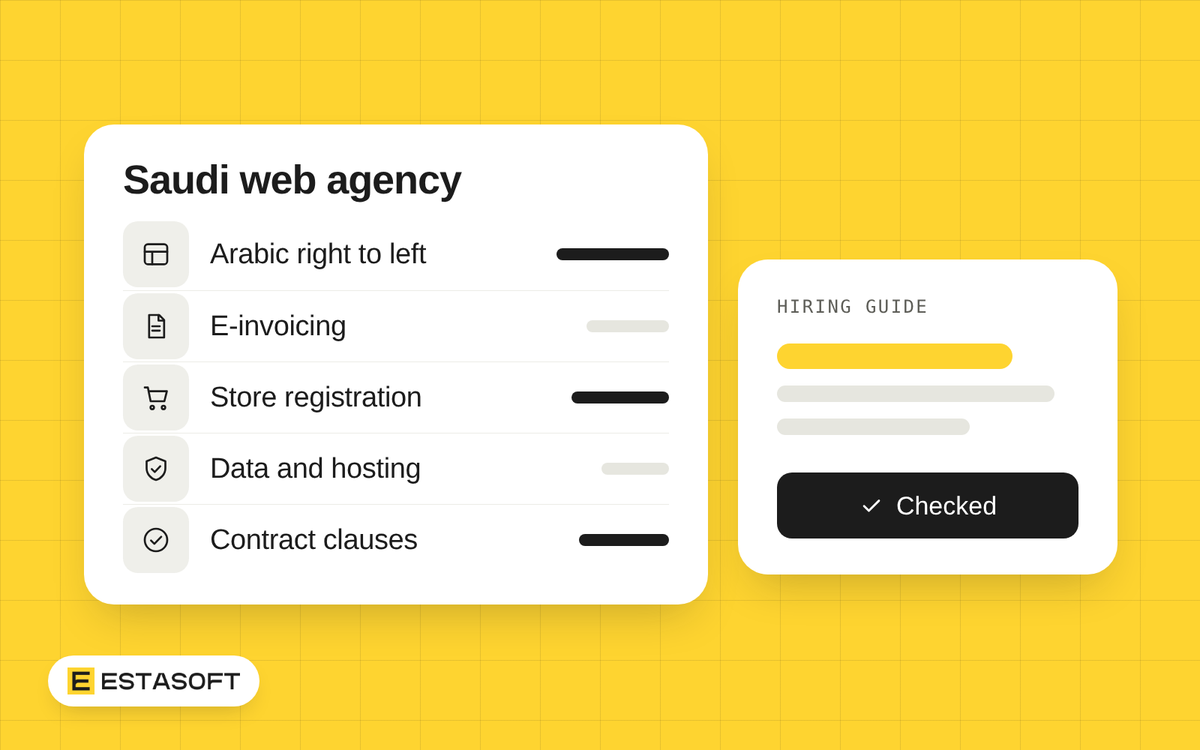
This guide puts those details first. It gives a short decision list for local, regional or remote, the Saudi requirements your agency should be able to show, a contract clause list and a set of red flags. ESTASOFT has offices in Dubai, Erbil and London, so treat this as advice from outside the Kingdom. It relies on official pages we opened on 3 November 2026. For the general hiring questions, read how to write a one page brief first.
Local, regional or remote: what changes
Where the agency sits changes how you work together. It does not decide whether the site is right. Use these points to weigh the three choices:
- Local. You can meet in person and share your working week. Ask what Saudi projects the team has built. A Saudi address alone proves little.
- Regional. The team may share your region's time zone and habits. Ask where the people who will do the work sit, and what they have built for Saudi customers, not only for their home market.
- Remote. You may find a skill you cannot find nearby. It needs tighter written process: a brief, weekly demos and a shared task list. Ask which working hours overlap with yours.
Four questions help you pick. Do you need workshops in person? How much of the work is Arabic content and design? Does the site connect to invoicing, payment or accounting systems? Who answers when checkout fails in the evening? Whichever choice you make, the checks below apply to all three.
Arabic and right to left: ask for proof
Arabic is more than translated text. The W3C says to set the direction on the html element and to declare the language too, because a language setting does not set direction. It prefers logical CSS properties such as start and end over left and right, and it recommends automatic direction detection for text inserted at run time. It also lists what goes wrong in mixed text: a phrase in the opposite direction that starts or ends with punctuation, or sits next to a number, can display in the wrong place.
Ask the agency to show you a working page with an English brand name and digits inside an Arabic sentence, an Arabic form, an Arabic order email and a printed invoice. If you plan a Shopify store, note that Shopify names its Horizon-family themes for right-to-left languages and tells you to confirm support in any other theme. Our guide to Arabic on a website: right-to-left, fonts and search goes deeper.
Invoices and e-invoicing: who builds what
ZATCA, the tax authority, says e-invoicing phase one applied from 4 December 2021 to all taxpayers except non-residents. Phase two is enforceable from 1 January 2023 in waves, and ZATCA says it will notify taxpayers of their wave at least six months ahead. A ZATCA announcement dated 24 July 2026 says wave 25 targets taxpayers whose VAT revenues exceeded SAR 187,500 in any of 2022 to 2025, and that they must connect to the Fatoora platform by 1 February 2027. Waves and dates can change.
ZATCA's invoicing guideline (version 3, May 2026) says invoices must be in Arabic, state VAT amounts in riyals and carry a QR code when issued electronically. Its text is hard to read in places, so ask your accountant to confirm the current wording. Then ask the agency three questions. Is invoicing in your quote, or does another supplier cover it? Has the team connected a store or system to Fatoora before, and can it show you? Who fixes it when the rules change? Our guide to Saudi e-invoicing questions for your developer has a longer list.
Store registration and the e-commerce law
The Saudi E-Commerce Law (Royal Decree M/126, English text on the Ministry of Investment site) says an e-shop must show the provider's name or identifying mark, address, contact details and commercial registration details (Article 6, with an exception for a shop registered with an e-shop authentication entity). It also says merchants must register their e-shop in the Commercial Register (Article 15). Article 18 lists penalties from a warning to a fine of up to 1,000,000 riyals, suspension of e-commerce activity and blocking of the store. The text is a translation and may not show later changes.
The Ministry of Commerce has published notices. One dated 14 April 2022 says online stores need a registration certificate from the Ministry or a freelance licence. One dated 29 March 2023 asks store owners to register on the Business Platform instead of Maroof, with a commercial registration or professional certificate and a commercial bank account. Both are old, so check the Ministry's current pages. Your lawyer decides what applies to you. The agency's job is to build the pages that show the details and to ask you for them before launch. Our Saudi store checklist covers the rest of the law.
Customer data and where it lives
Article 5 of the same law says a store may keep customers' personal data only as long as the transaction needs, unless the parties agree otherwise. It must protect that data and not share it without consent unless the law requires it. Separately, ZATCA's invoicing guideline says tax records must be kept electronically in the Kingdom on a server located there, and allows a central system abroad if the records can be reached from a workstation at a permanent establishment in the Kingdom. It says a non-resident with no tax representative in the Kingdom must appoint a third party there to keep them. We could not open an official text of Saudi Arabia's personal data protection rules for this article, so we do not summarise them. Ask your lawyer which rules apply to your site and whether customer data may be stored or processed outside the Kingdom.
Then ask the agency to write down, for every part of the project, which country holds the data:
- The website and its database, and each backup copy.
- Email, forms and analytics tools.
- Each plugin or app that collects customer details.
- Who holds admin access, and how you remove it.
- What the agency deletes, and when, at the end of the contract.
Payments you can switch on
The Saudi Central Bank says mada cards can pay online through 3D Secure. Shopify's page lists 41 countries for Shopify Payments, and Saudi Arabia is not one of them. So ask the agency which payment providers it has connected for Saudi stores before, and ask to see a test order for each method you need. The merchant account must be in your company's name, and you should hold the keys. Connecting a provider is web development work, so put it in the written scope.
Contract clauses to ask for
Ask your lawyer to review the final contract. These clauses are a starting list to raise:
- Scope. Plain words on Arabic pages, invoices, payments, data moves and what is excluded.
- Ownership. Who owns the code, designs and content, and when it passes to you. Read who owns the code first.
- Accounts. Domain, hosting, store, payment provider and analytics in your company's name.
- Languages. Which language version of the contract prevails, who writes the Arabic text and who proofreads it.
- Acceptance. A list of tests, run on phones in Arabic, that must pass before you pay the final milestone.
- Changes. How the agency prices work outside the scope.
- Support. What the agency fixes after launch, for how long and how fast it replies.
- Data. Where it is stored, who may access it, which subcontractors are named and what is deleted at the end.
- Tax. The supplier's VAT number on each invoice. ZATCA's guideline lists the supplier's VAT registration number among required invoice details. If the agency is outside Saudi Arabia, ask your accountant how VAT and any withholding tax apply to payments abroad.
- Exit. Handover of files, credentials and notes, and how long handover takes.
- Law and disputes. Governing law and where disputes go. This one is for your lawyer.
Red flags
- The agency has no Saudi example it can show you, or it names clients without letting you see the sites.
- It says "ZATCA ready" without saying who issues the invoice and who connects to Fatoora.
- It will not put domain, hosting or payment accounts in your name.
- It cannot show a mixed Arabic and English page that displays correctly on a phone.
- The quote has no line for invoicing, payments or data.
- It pushes you to sign before you have seen a written scope.
Compare two or three quotes against the same written brief, and ask each agency the same questions on the first call.
This is general information, not legal or tax advice. Check the current rules or ask a qualified adviser before you decide.
Need a hand?
If you are weighing a build for the Saudi market, ESTASOFT can help through our web development service. Send a short brief on the contact page, and compare our answers with the checks above.
Sources
- W3C: structural markup and right-to-left text in HTML: Set direction and language on the html element, logical CSS properties, automatic direction detection for run-time text (checked 3 November 2026)
- W3C: inline markup and bidirectional text in HTML: Mixed-direction text problems with punctuation and numbers next to a phrase in the opposite direction (checked 3 November 2026)
- Shopify Help Center: requirements for selling in multiple languages: Horizon-family themes for right-to-left languages; confirm support in other themes (page undated) (checked 3 November 2026)
- Shopify Help Center: supported countries for Shopify Payments: 41 countries listed for Shopify Payments and Saudi Arabia not among them (page undated) (checked 3 November 2026)
- ZATCA: e-invoicing roll-out phases: Phase one from 4 December 2021 (excluding non-residents); phase two from 1 January 2023 in waves with at least six months notice (page last updated 1 September 2026) (checked 3 November 2026)
- ZATCA: twenty-fifth wave of the e-invoicing integration phase (24 July 2026): Wave 25 criteria and the 1 February 2027 deadline (checked 3 November 2026)
- ZATCA: guideline for tax invoicing and records under VAT provisions (version 3, May 2026): Arabic invoices, riyals, QR code on electronic invoices, supplier VAT number, records kept electronically in the Kingdom, non-resident record keeping (file text hard to read in places) (checked 3 November 2026)
- Saudi E-Commerce Law, Royal Decree M/126 (English text, Ministry of Investment site): Articles 5, 6, 15 and 18 on personal data, store details, registration and penalties; a translation that may not show later changes (checked 3 November 2026)
- Ministry of Commerce: online stores must be registered (14 April 2022): Registration certificate or freelance licence for online stores (checked 3 November 2026)
- Ministry of Commerce: registering e-stores on the Business Platform (29 March 2023): Business Platform replaces Maroof; certificate and commercial bank account required (checked 3 November 2026)
- Saudi Central Bank (SAMA): mada: mada cards can pay online through 3D Secure (checked 3 November 2026)