
When you pay a developer, an agency or a freelancer to build software, you may assume you own the code. In several countries that is not automatic. This guide is for owners and managers who commission custom software, a website or an app. It explains who owns the code, what common open-source licenses require, and what a handover should contain.
This is general information, not legal advice. Laws differ by country and by contract, so check with a qualified lawyer in your country and have a lawyer review your contract before you sign it. We read the legal texts below on 30 October 2026.
Paying for the code does not always mean owning it
Copyright law starts from the person who creates a work, not the person who pays. In the UK, the Copyright, Designs and Patents Act 1988 makes the author, meaning the person who creates the work, the first owner of the copyright, subject to exceptions (sections 9 and 11). Section 3 lists a computer program as a type of literary work. So the code is a copyright work, and the question is who owns that copyright. It often turns on one point: was the writer your employee, or an outside contractor?
What the law says in the UK, the US, Canada and the EU
United Kingdom
Section 11(2) says that when an employee makes a literary work in the course of employment, the employer is the first owner, subject to any agreement to the contrary. GOV.UK guidance from the Intellectual Property Office says a freelancer or agency working under a contract for services will usually keep copyright unless the contract says otherwise.
Section 90(3) sets a formal rule: an assignment of copyright is not effective unless it is in writing and signed by or on behalf of the person giving the copyright up. If the contract is silent, GOV.UK notes that a court may find an implied license to use the work for the purpose it was commissioned. That may be a limited, non-exclusive license, not ownership.
United States
Under 17 U.S.C. 101, a work made for hire qualifies in two cases. The first is a work prepared by an employee within the scope of employment. The second is a work specially ordered or commissioned for one of nine listed uses, and only if both parties sign a written agreement saying it is a work made for hire. The nine are a contribution to a collective work, a part of a motion picture or other audiovisual work, a translation, a supplementary work, a compilation, an instructional text, a test, answer material for a test, and an atlas (US Copyright Office, Circular 30).
Software is not named in that list. For commissioned software, a signed written assignment is therefore the usual route, and a lawyer should check whether any category fits your project. Section 204(a) says a transfer of copyright ownership, other than by operation of law, is not valid unless an instrument of conveyance, or a note or memorandum of the transfer, is in writing and signed by the owner of the rights or the owner's authorized agent.
Canada
Section 13(3) of the Copyright Act says that when an author makes a work in the course of employment under a contract of service or apprenticeship, the employer is the first owner, unless they agreed otherwise. Section 13(4) says no assignment or grant is valid unless it is in writing signed by the owner of the right or the owner's authorized agent.
Canada also protects moral rights, such as an author's right to protect the integrity of a work. Section 14.1(2) says they may not be assigned but may be waived in whole or in part. Section 14.1(3) adds that assigning copyright does not, by itself, waive them.
European Union
Directive 2009/24/EC of 23 April 2009 covers the legal protection of computer programs. Article 2(3) says that when an employee creates a program in the execution of his duties, or following the employer's instructions, the employer alone may exercise all economic rights in it, unless a contract provides otherwise. Article 2 says nothing about outside contractors, so national law decides who owns a program they write.
Assignment or license: decide on purpose
An assignment transfers ownership, in whole or in part. A license gives permission to use while someone else stays the owner. Off-the-shelf products usually come with a license, not the code. Our guide on custom software or off-the-shelf compares the routes. For custom work, treat each part separately:
- Code written for you: ask for an assignment, signed by both sides, that takes effect on payment in full or earlier.
- The developer's reusable tools: expect a license, not an assignment. Ask that it covers your use and does not end when the project ends.
Our custom software page says ownership and licensing are agreed in the contract before work starts. That is the right moment, because a dispute is a poor time to find a missing signature.
Open-source licenses inside your project
Most projects include open-source components, and each has a license. Three common ones, as published by the Open Source Initiative and the Apache Software Foundation:
- MIT: anyone may use, copy, modify, publish, distribute, sublicense and sell the software. The one condition is that the copyright notice and permission notice stay with all copies or substantial portions. There is no warranty.
- Apache 2.0: it grants a copyright license and a patent license. If you sue anyone claiming the work infringes a patent, your patent licenses for it end on the day you file. When you redistribute, you must pass on the license, mark changed files and keep notices, including any NOTICE file.
- GPL-3.0: it is stricter. Section 5 says that when you convey a modified version, you must license the entire work under the GPL for anyone who gets a copy. Section 6 says that when you convey compiled code, you must also provide the Corresponding Source, for example through a written offer valid for at least three years.
These GPL duties concern passing copies to others. WordPress is released under GPLv2 or later, and the WordPress.org license page says the project feels strongly that plugins and themes are derivative works that inherit the GPL. If you commission a WordPress theme or plugin, ask how that affects your code.
What a handover should include
Owning the copyright helps little if the code sits in an account you cannot open.
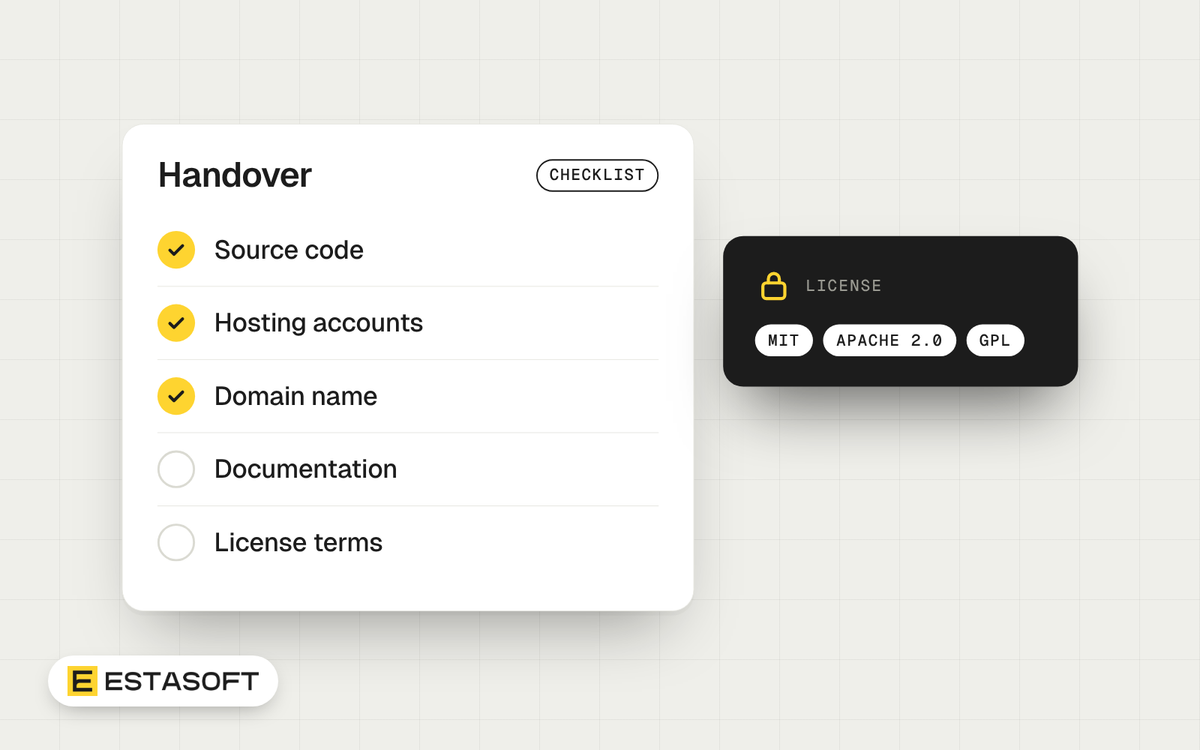
- Source code repository with full history, in an account your company owns.
- Build and release instructions that a different developer can follow.
- Hosting, cloud, payment, email and analytics accounts with your company as owner and billing contact.
- Domain registration and DNS in your company's name. Our guide to domains, DNS and hosting explains what to control.
- Configuration values and secrets, sent by a safe channel and replaced after handover.
- A database export, a description of the data structure and documentation of the integrations.
- Design files, fonts and images, with their licenses.
- A list of open-source and third-party components with licenses and versions, plus the signed assignment or license documents.
If the code is on GitHub, the GitHub Docs explain transfers. At the time of writing (30 October 2026), a repository transfer carries issues, pull requests, the wiki and the commit history. You need admin access to the repository, and permission to create repositories in the target organization. GitHub does not redirect links to a GitHub Pages site. The simplest path is to create the repository in your company's account on day one.
If you depend on software you will not own, ask about escrow. UK government commercial guidance (updated 30 September 2026) describes a neutral third-party specialist that securely holds the source code and releases it under conditions set in the contract, so the buyer can keep the software running if the supplier fails. Read those conditions closely.
Contract clauses to ask for
Take this list to your lawyer. It is a starting point.
- Ownership and timing: the supplier assigns the rights to you in a document signed by both sides, and the clause says when.
- People: the supplier confirms that its employees and subcontractors have transferred their rights to it, so it can pass them on.
- Existing tools: reusable tools are listed in an appendix, with a license to use them that does not end with the project.
- Open source: the supplier lists each component and license, and asks your approval before adding code under strict conditions, such as GPL-3.0.
- Moral rights: where Canadian law applies, a clear clause on waiver.
- Handover: deliverables like the checklist above, a date, who accepts them, and what happens if the contract ends early. Our guide on fixed price or time and materials covers milestones and acceptance.
- Governing law: which country's law applies.
Add these points to our list of questions to ask before hiring an agency.
Mistakes to avoid
- Assuming that an invoice or a payment transfers ownership.
- Relying on informal messages. The UK, US and Canadian rules above call for a signed writing, so ask your lawyer what counts as signed.
- Letting the supplier own the hosting, domain, repository or payment accounts.
- Using work made for hire wording for an outside developer in the US without checking the nine categories.
- Ignoring the licenses of the components inside the code.
Questions owners ask
If I paid a freelancer to build my app, do I own it?
Not automatically. In the UK, GOV.UK guidance says a freelancer usually keeps copyright unless the contract says otherwise. In the US and Canada, a transfer also needs a signed writing, so ask for a signed assignment.
What is the difference between an assignment and a license?
An assignment moves ownership, in whole or in part. A license lets you use the work while someone else stays the owner. If a contract says nothing, a UK court may find an implied license, which GOV.UK says may be limited and non-exclusive.
Can I use open-source code in a commercial product?
Often yes, but the license decides. MIT, for example, allows selling copies if the notices stay. GPL-3.0 adds duties when you convey the software, so ask before GPL code goes into a product you distribute.
Need a hand?
If you plan a custom software project, our custom software page describes the work we do. Send a short brief on the contact page and we reply with next steps. Your lawyer should still review any contract.
Sources
- legislation.gov.uk: Copyright, Designs and Patents Act 1988, sections 9 to 11
- legislation.gov.uk: Copyright, Designs and Patents Act 1988, section 3
- legislation.gov.uk: Copyright, Designs and Patents Act 1988, section 90
- GOV.UK: Ownership of copyright works
- U.S. Copyright Office: Circular 30, Works Made for Hire
- GovInfo: 17 U.S.C. chapter 1, section 101
- GovInfo: 17 U.S.C. 204
- Justice Laws Website (Canada): Copyright Act, section 13
- Justice Laws Website (Canada): Copyright Act, section 14.1
- legislation.gov.uk: Directive 2009/24/EC on computer programs
- EUR-Lex: Directive 2009/24/EC
- GOV.UK: Assessing and monitoring the Economic and Financial Standing of Suppliers guidance note
- Open Source Initiative: The MIT License
- Apache Software Foundation: Apache License 2.0
- Open Source Initiative: GNU General Public License version 3
- WordPress.org: License
- GitHub Docs: Transferring a repository