
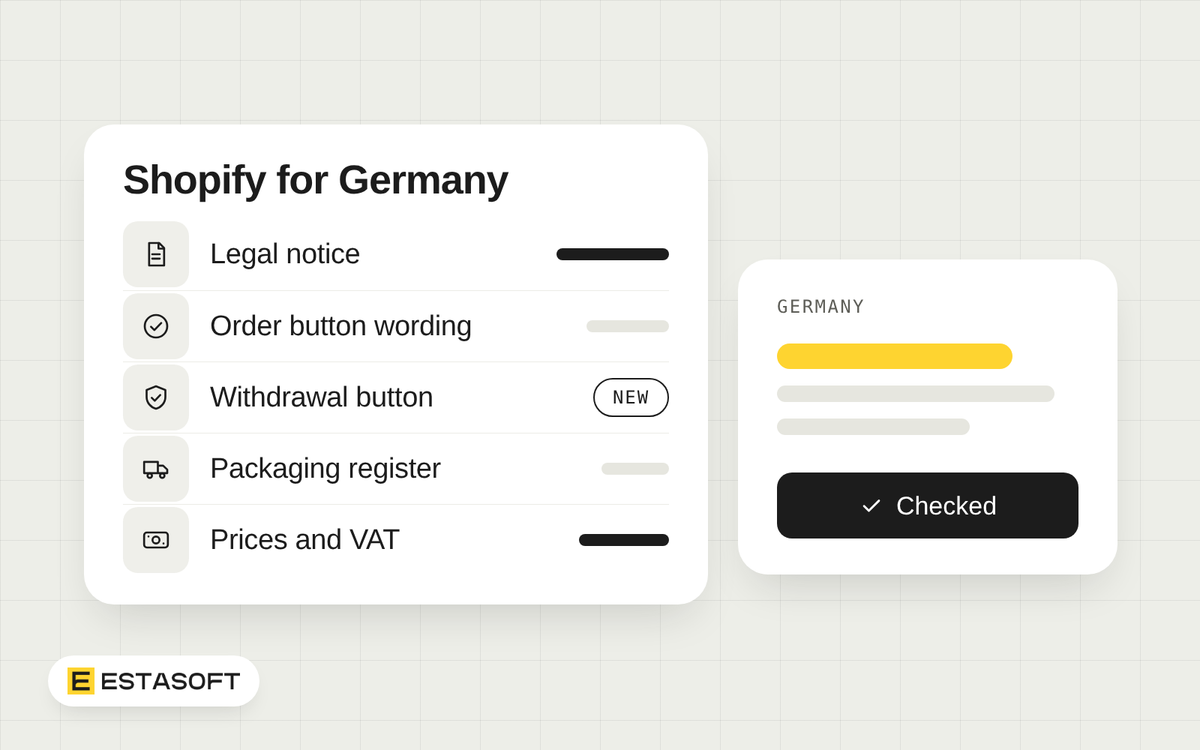
Germany has detailed rules for online shops. A store that runs well in the Gulf or the US can still miss a legal notice, a price detail, an order button label or the newer withdrawal button. This guide walks through the points that official texts address and what to check in your store.
Every rule below comes from a page read on 3 November 2026. Where no official page could be opened, the guide says so and gives you a question for your adviser instead of a rule. Laws and dates can change, so check the current text before you launch.
Start with the legal notice (Impressum)
Section 5 of the Digitale-Dienste-Gesetz (DDG) says what a provider of commercial digital services must show. The information must be easy to recognise, directly reachable and available at all times. According to the IHK Gera, online shops must publish it, and the section has applied since May 2024. It lists:
- The name and address of the business. For a company, also the legal form and the people who may represent it.
- Details for fast electronic contact, including an email address.
- The commercial register and register number, if the business is entered in one.
- The VAT identification number or business identification number, if you have one.
- The supervisory authority, if your activity needs an official licence.
Other laws can add duties, so ask your adviser which apply to you. Link the notice from the footer of every page.
Show total prices and unit prices
The Preisangabenverordnung (PAngV) covers how prices are shown to consumers.
- Total price. A business that offers goods to consumers with prices must state total prices. Section 2 defines the total price as the amount payable, including VAT and other price components.
- Unit price. For goods sold by weight, volume, length or area, section 4 asks for a unit price next to the total price. It must be clearly visible and easy to read. Exemptions exist, for example for goods with a nominal content under 10 grams or millilitres, so ask which apply to your range.
- Delivery and payment information. Section 312j(1) of the Civil Code (BGB) says you must state clearly and prominently, before the ordering process begins, whether delivery restrictions apply and which payment methods you accept.
Check the store as a German visitor sees it: product pages, collection pages and cart. The pages read do not say how shipping costs must be shown, so ask your adviser.
Check the order button and the last page before payment
Section 312j of the BGB sets rules for the end of the checkout.
- Immediately before the buyer orders, key pre-contract information must be shown in a clear, understandable and highlighted way. The section points to Article 246a of the introductory act (EGBGB) for the list. That list was not opened for this guide, so ask your adviser for it.
- The buyer must expressly confirm that the order obliges them to pay. A button must be easy to read and carry only the words zahlungspflichtig bestellen or an equally clear wording.
- The section says the contract is concluded only if you meet the button and confirmation duty.
The last point makes this a commercial risk as well as a legal one. Place a test order on your German store and read the button. Do not assume the default text meets the rule.
Add the withdrawal right and the new withdrawal button
Under section 355 of the BGB, a consumer has 14 days to withdraw from a contract. They need no reason, and a clear statement to the business is enough. For goods, the day the period starts follows other sections that were not opened here, so confirm it with your adviser.
There is also a newer duty. EU Directive 2023/2673 told member states to apply a rule on a withdrawal function from 19 June 2026, for distance contracts concluded through an online interface such as a website or app. According to the law firm Noerr, Germany published its implementing act on 5 February 2026, and a new section 356a BGB took effect on 19 June 2026. The IHK Braunschweig gives the same date, although that page also calls the rules a draft in places. The statute text itself was not opened for this guide, so ask your adviser to confirm it. The function must:
- Be labelled so the buyer can see it withdraws from the contract. The IHK and Noerr give the German wording Vertrag widerrufen or an equivalent.
- Stay available throughout the withdrawal period, prominently displayed and easy to reach. The IHK says the buyer should not need to log in, and you may not ask for a reason.
- Let the buyer give or confirm their name, details that identify the contract and the electronic channel for the reply.
- Include a second, clearly labelled confirmation step (Widerruf bestätigen or an equivalent).
- Trigger an acknowledgement on a durable medium, such as email, without undue delay, with the content of the withdrawal and the date and time submitted.
The IHK Braunschweig warns that non-compliance can lead to warnings or fines and can extend the withdrawal period (it names 12 months and 14 days). It says a separate cancellation button for continuing obligations is a different duty, so ask about it if you sell subscriptions. It also names further information duties from 27 September 2026, on warranties, repairability and eco-friendly delivery options. Ask whether they apply to your products.
For your Shopify store, check where the button sits, whether it works in German, who receives the requests and whether the acknowledgement email goes out by itself. If you use an app for this, test it against the list above, because an app listing's claim of compliance is the publisher's own claim. For refunds and return costs, see our guide to returns and refunds rules.
Register your packaging
Germany keeps a packaging register called LUCID, run by the Zentrale Stelle Verpackungsregister (ZSVR). Its information sheet for online sellers is dated July 2021, so treat the details as a starting point and check what applies today. The sheet says:
- Online sellers who fill shipping packaging with goods as a business must register. There is no small-quantity exemption.
- Foreign online shops that ship directly to German consumers count as importers and must register. The sheet says this covers shipping packaging and product packaging that typically becomes household waste, and includes shipments from other EU countries.
- A business without a German branch can appoint an authorised representative in Germany for most duties, but not for registration. The ZSVR FAQ says registration is online, done by the company itself and free of charge.
- You must also join a dual system that collects household packaging and report volumes to it and to the ZSVR. Buying licensed packaging on its own does not meet the duty.
- If a fulfilment provider ships for you, you count as the manufacturer of the shipping packaging. From 1 July 2022, fulfilment providers may only work for sellers who are registered and in a system.
Electronics, batteries and product safety
If you sell electrical equipment or products with batteries, ask your adviser whether a German registration or take-back duty applies to you. No official page on this was opened for this guide, so it states no rule. For product safety information on product pages, see our guide to EU product safety rules for online sellers.
VAT: what the sources show and what to ask
The pages opened for this guide show two VAT points: consumer prices must be total prices that include VAT, and the legal notice must show your VAT identification number if you have one. No official German tax page was opened, so this guide states no registration rule, threshold or rate. Take these questions to a tax adviser:
- Do I need to register for VAT in Germany, or can I use a one-stop scheme for EU sales?
- Which rate applies to each product?
- What must my invoices show?
- How do duties and VAT work for parcels that start outside the EU?
Our guide to selling into the EU from outside it covers the EU-wide side.
Payments, language and dispute notices
Payments. Shopify's Help Center says Klarna can be offered through Shopify Payments in Germany and shown to buyers there. It lists four options: pay in 30 days, pay in full through online banking, pay in three instalments and financing. The store must show its business tax ID, contact details, delivery information, return instructions and withdrawal policy, and Klarna makes the final decision on eligibility. Klarna can be used only in euros, according to that page. Ask your payment provider which methods work for a company based in your country. The pages opened do not name the methods German buyers use most. Ask your payment provider for a Germany-specific list.
Language. No page opened for this guide says every German-facing store must be in German. Section 312j asks for clear and understandable information, so ask your adviser whether English-only legal pages are acceptable for you. Our guide to selling in several countries with Shopify Markets covers the setup.
Dispute notices. The IHK Gera page, dated 14 May 2025, says the EU planned to shut down its online dispute platform on 20 July 2025 and that the related information duty would end then, so check your templates for old links. It also says traders must tell consumers whether they are willing or obliged to join consumer arbitration, with an exemption for traders with 10 or fewer employees on 31 December of the previous year.
Privacy. The same page says the privacy policy needs its own page, one click from every subpage (see privacy and cookies on a Shopify store).
A pre-launch checklist for a German-facing store
- The legal notice is complete, linked from every page and reachable from checkout.
- Every price a German visitor sees is a total price with VAT, with unit prices where the rule applies.
- Delivery restrictions and accepted payment methods are visible before checkout starts.
- A test order shows the key information before payment, and the button wording meets section 312j.
- The withdrawal button works without a login, asks no reason, has a confirmation step and sends an acknowledgement with date and time.
- Packaging registration is done, or your adviser says it is not needed.
- Duties for electronics, batteries and product safety are checked, and old dispute platform links are gone.
This is general information, not legal or tax advice. Check the current rules or ask a qualified adviser before you decide.
ESTASOFT offers Shopify solutions and has offices in Dubai, Erbil and London. It does not replace a German legal adviser. If you want a store prepared for German customers, our Shopify solutions page explains the work, and you can send a short brief on the contact page.
Sources
- Digitale-Dienste-Gesetz, section 5: legal notice contents (checked 3 November 2026)
- Civil Code, section 312j: order process, button wording, payment and delivery information (checked 3 November 2026)
- Civil Code, section 355: 14-day withdrawal right (checked 3 November 2026)
- PAngV, section 2: definition of total price (checked 3 November 2026)
- PAngV, section 3: duty to state total prices (checked 3 November 2026)
- PAngV, section 4: unit price rule and exemptions (checked 3 November 2026)
- Directive (EU) 2023/2673, EUR-Lex: withdrawal function and the 19 June 2026 application date (checked 3 November 2026)
- IHK Braunschweig, withdrawal button: German implementation, labels, caveats (checked 3 November 2026)
- Noerr, implementing act for the withdrawal button: law firm commentary on publication date (5 February 2026), effect date (19 June 2026) and content (page dated 13 March 2026) (checked 3 November 2026)
- ZSVR information sheet for shipping and online trade (July 2021): packaging register duties (checked 3 November 2026)
- ZSVR FAQ, registration process: how foreign companies register (checked 3 November 2026)
- IHK Gera, basics of online trade: legal notice, dispute platform, consumer arbitration notice, privacy page (page dated 14 May 2025) (checked 3 November 2026)
- Shopify Help Center, Klarna: Klarna in Germany, its options, euro-only payment and conditions (checked 3 November 2026)