
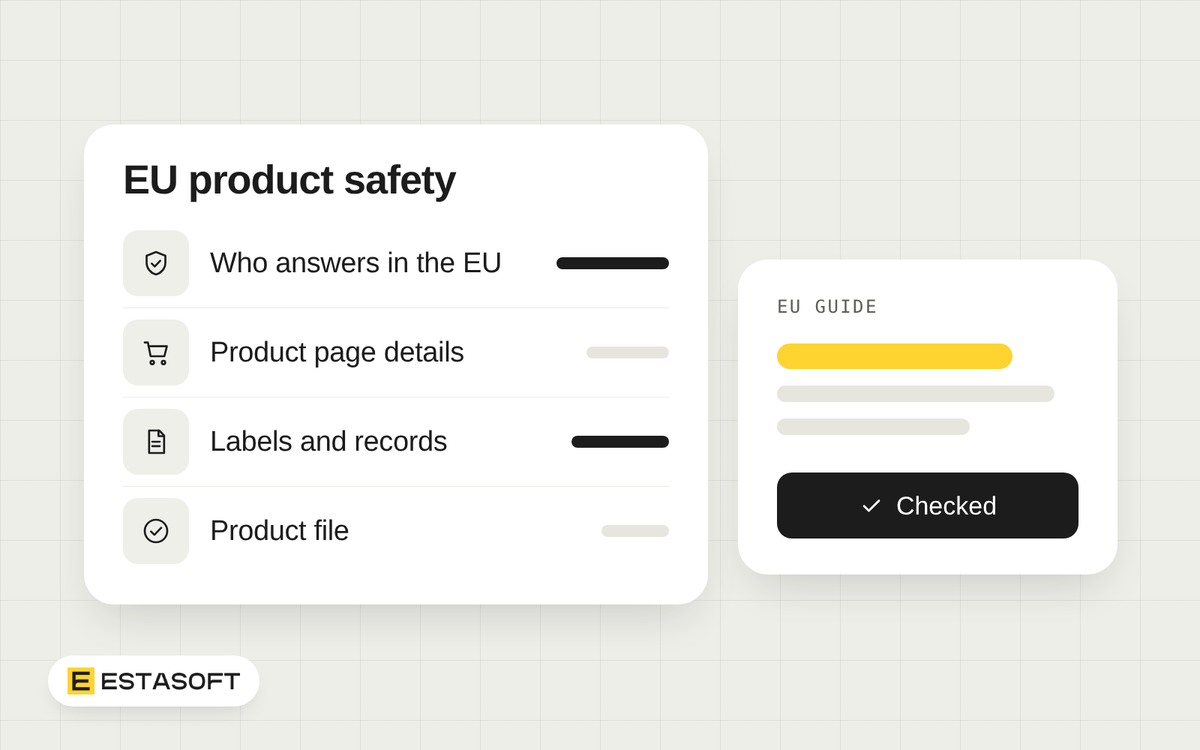
You sell from outside the EU and a customer in France or Italy wants your product. Before VAT and duty, there is a product question: is the item safe, and who in the EU answers for it? The EU's general product safety rules sit in Regulation (EU) 2023/988, often called GPSR. They affect what your product page must show and who you need to name in the EU.
This article sets out what the official texts say: the regulation on EUR-Lex, the European Commission's guidelines for businesses, and Commission and Council pages, all read on 3 November 2026. It turns them into a product page checklist and a product file. Your product type may also fall under another EU law, so confirm the details with the official text or a qualified adviser. For VAT and duty, see selling into the EU from outside it. For the wider market picture, see selling from the Middle East to the UK, Europe, the US and Canada.
What the regulation is and when it applies
The regulation sets general safety rules for consumer products. According to the Commission, it has applied since 13 December 2024 and replaced the earlier General Product Safety Directive. The regulation text covers new, used, repaired and reconditioned products. It leaves out some categories, including medicines, food and antiques. Where another EU law already governs a product's safety, the regulation covers only the aspects that law does not. So ask first which law covers each of your products.
The Commission's guidelines for businesses (Commission Notice C/2025/6233, shown as 21 November 2025 on EUR-Lex) explain the rules in plain terms. They are not binding. Only the legal text is. The consolidated text I read is dated 29 May 2026, is marked for documentation only, and shows that the regulation has been amended since it was published, so check you have the current wording.
Does it reach a store outside the EU?
Article 4 says an online offer counts as made available on the EU market when it targets consumers in the Union, meaning the seller directs its activities at one or more Member States. The guidelines say this is judged case by case. Signs include delivery areas, languages used, accepted payment methods, the currency of a Member State and a domain name registered there. If your store ships to EU countries, offers an EU language or takes EU payment methods, ask your adviser whether your offers are covered.
Who must be named in the EU
Article 16 says a covered product can be placed on the EU market only if an economic operator established in the Union is responsible for it. This person, called the responsible person, checks the product against its technical documentation and labelling and keeps evidence of those checks for the authorities. Their name, trade name or trademark and contact details must appear on the product, its packaging or an accompanying document. The guidelines add the parcel.
The guidelines list the possible holders of the role: an importer, an authorised representative that the manufacturer has mandated in writing, or a fulfilment service provider. They define a fulfilment service provider as one that offers at least two of warehousing, packaging, addressing or dispatching without owning the goods. Postal, parcel delivery and freight services alone are excluded, so do not assume your courier fills the role.
You may also be the manufacturer. The guidelines say a manufacturer markets a product under its own name or trademark, even if someone else made it. Their example is a company that buys mugs, adds its own logo and sells them. If you sell under your own brand, ask your adviser whether you count as the manufacturer. Questions for anyone offering to be your responsible person:
- Will you be named as the responsible person, and is that in writing?
- Which documents do you hold, and which checks do you make on my products?
- What do you charge, and what happens if a product is recalled?
- Are you also my customs representative, or is that someone else?
What your product page must show
Article 19 covers online offers. According to the regulation text, an offer must clearly and visibly show at least:
- The manufacturer's name, registered trade name or trademark, and postal and electronic address.
- If the manufacturer is outside the EU, the name and postal and electronic address of the responsible person.
- Information that identifies the product, including a picture, its type and any other product identifier.
- Any warning or safety information the product needs, in a language consumers can easily understand, as decided by the Member State where you sell.
The guidelines say an electronic address must allow direct contact, so a link to a website alone is not enough. Language is set country by country. List the countries you sell to and ask your adviser which language each requires. Add these fields to your online store page template so no product goes live without them.
Consumer law is a separate rulebook on the same page. Your Europe says traders must give EU consumers details such as identity and addresses, the total price including taxes and delivery, withdrawal conditions and complaint handling before the sale. For returns, see returns and refunds rules for the UK, EU, US and Canada.
What goes on the product, and what to keep
The regulation puts these duties on the manufacturer, which may be you or your supplier:
- Carry out a risk analysis and prepare technical documentation. Keep it up to date for 10 years after the product is placed on the market.
- Put a type, batch or serial number, or an equivalent, where consumers can see it. If that is not practical, use the packaging or an accompanying document.
- Put the manufacturer's name, trade name or trademark and postal and electronic address on the product, its packaging or an accompanying document.
- Supply clear instructions and safety information in a language consumers can easily understand, as set by the Member State.
- Investigate complaints and accident reports, and keep an internal register of complaints, recalls and corrective measures.
Importers and distributors have their own checks. An importer must check that the manufacturer has met its documentation and labelling duties, show its own name and contact details on the product or packaging, and keep a copy of the technical documentation for 10 years. A distributor must check the labelling and must not sell a product that does not conform.
If a product turns out to be unsafe
According to the regulation text, a manufacturer who has reason to believe a product is dangerous must act at once. That means corrective measures such as withdrawal or recall, informing consumers and notifying authorities through the Safety Business Gateway. Accidents that cause death or serious effects on health must also be notified through the Gateway without undue delay, to the authority of the country where the accident happened.
Write a one-page plan before it happens. Name the person who decides, how customers can report a problem, how you would stop sales, how you would reach buyers, and where you record each step.
Marketplaces and penalties
If you sell through an online marketplace, the Council says marketplaces must cooperate with market surveillance authorities and have a single point of contact for product safety. Authorities can order them to remove dangerous products. Your Europe adds that marketplace providers must register on the EU Safety Gate.
Penalties are set by each Member State. The regulation says they must be effective, proportionate and dissuasive. Ask what applies in the countries where you sell most.
Customs product identifiers are a separate step
Customs asks for product data too. The Commission's customs guidance says product identifiers for distance sales in consignments up to €150 were voluntary from 1 July 2026 and are enforced from 1 November 2026. It says the requirement followed a large customs control operation, run with market surveillance authorities, that found a high share of low-value goods imported directly did not comply with EU product requirements and safety rules. The identifiers are a customs requirement, separate from the page rules above. Keep the model, batch and maker details the same on your page, in your product file and in your customs data. The detail is in the VAT and duty article.
Build a product file for every item
The regulation names what a manufacturer must keep. The rest of this list is good practice. It lets you answer an authority, a carrier or a customer quickly.
- The manufacturer's legal name, trade name or trademark, and postal and electronic addresses, plus those of your responsible person.
- The model name, the type, batch or serial format, and photos of the product and its labels.
- Instructions and safety information, in the language of each country you sell to.
- The technical documentation and risk analysis, and where they are kept for 10 years.
- Any test reports, certificates and supplier declarations, with dates.
- A log of complaints, accidents, recalls and corrective measures.
- A change log, so you know which version of a product shipped when.
- Your customs data: tariff code, country of origin and product identifiers.
If you use print-on-demand or dropshipping, check that your supplier can provide this file before you list the product.
Questions to put to an adviser
- Is each product a consumer product under this regulation, or does another EU law cover it?
- Am I the manufacturer, an importer or a distributor for each product, and how does that change if I use dropshipping or print-on-demand?
- Who is my responsible person, and what does the contract say?
- Which language does each country I sell to require for instructions and warnings?
- What must be on the product or its packaging, and what can sit on the product page?
- How long must I keep records, and whom do I tell if an accident happens?
- What penalties apply in the countries where I sell?
- Does my marketplace or fulfilment partner take on any of these duties, and is that in the contract?
Key dates
- 12 June 2023: the regulation entered into force, according to the Commission's factsheet.
- 13 December 2024: the regulation applies.
- 1 July 2026: customs product identifiers can be supplied voluntarily.
- 1 November 2026: customs product identifiers are enforced for distance sales up to €150.
Dates, texts and guidance can change, so check the official pages before you plan a launch.
This is general information, not legal or tax advice. Check the current rules or ask a qualified adviser before you decide.
ESTASOFT can help you set up product pages that carry the information above, through its eCommerce service and its Shopify solutions. Send a short brief on the contact page. The product file works whether you hire anyone or not.
Sources
- Consolidated text of Regulation (EU) 2023/988, version of 29 May 2026: EUR-Lex: scope, Articles 4, 9, 11, 12, 16, 19, 20 and 44 (documentation only, not the authentic version) (checked 3 November 2026)
- Regulation (EU) 2023/988: EUR-Lex: the act's record page, with its publication and application dates in the page data (checked 3 November 2026)
- Guidelines on the application of the EU general product safety legislative framework by businesses (Commission Notice C/2025/6233): EUR-Lex: targeting test, responsible person, fulfilment service providers, manufacturer definition, online offers, electronic address (21 November 2025; not binding) (checked 3 November 2026)
- New General Product Safety Regulation factsheet: European Commission: entry into force 12 June 2023 and application from 13 December 2024 (1 July 2023) (checked 3 November 2026)
- EU's General Product Safety Regulation (GPSR): a new era of consumer protection: Access2Markets: application date, scope and examples of the EU responsible operator (6 January 2025) (checked 3 November 2026)
- Product safety and market surveillance: Council of the EU: duties of online marketplaces (no page date) (checked 3 November 2026)
- B2C e-commerce, distance and off-premises selling: Your Europe: consumer information before the sale and the GPSR and Safety Gate mentions (last modified 12 July 2026) (checked 3 November 2026)
- The temporary EUR 3 customs duty and the Union handling fee: guidance for Member States and trade: European Commission: product identifiers and the customs control operation behind them (version of 5 October 2026; not legally binding) (checked 3 November 2026)
- Guidance and legal text on temporary flat fee on low-value imports: European Commission: dates of the product identifier requirement (published 8 June 2026, updated 20 July 2026) (checked 3 November 2026)