
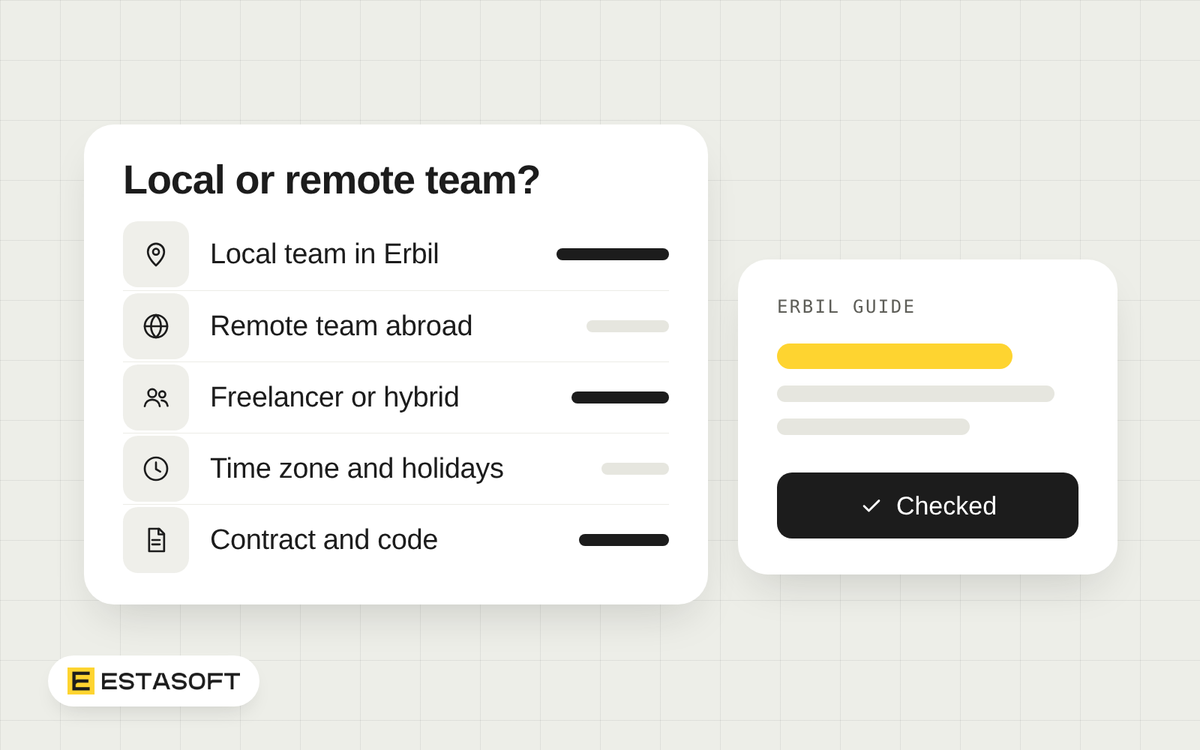
You need a new company website or web application, and the teams you could hire sit in different places. One is in Erbil. Another is abroad. A freelancer offers to do it alone. The choice depends less on the quote than on how the work will run week after week: when you can talk, which holidays stop the work, who can write and check Arabic and Kurdish, and how you pay.
This guide compares four ways to hire for web development and then walks through the points that decide it. It ends with a paid trial project you can use to test any team before you commit. Facts come from pages we read on 3 November 2026, listed at the end. Where we could not confirm a fact, we give a question to ask instead.
The four options
A local team in Erbil. You can meet in person and you share a working day. You choose from the teams in one city, so check that the team has the exact skills your project needs.
A remote team abroad. You can choose from teams in many countries, which helps when you need a rare skill. The cost is the time gap, a different holiday calendar and payment across borders. Most of this guide is about managing those three.
A freelancer. One person can start quickly and work flexibly. The risk is that the whole project depends on that person. Illness, travel or a new full-time job can stop it. Ask who covers when the freelancer is away, and make sure you hold every login and file.
A hybrid. A local project lead or designer handles meetings, content and decisions in Erbil, while remote specialists build parts of the site. This adds a second contract and a handover between two groups, so write down who is responsible for what.
Whichever you pick, ask who will do your work and which city they work from, and put the answer in the contract.
Time zone and overlap
According to timeanddate.com and Worldometers, Erbil keeps Arabia Standard Time, which is UTC+3, all year and does not use daylight saving time. A timeanddate.com news item reports that Iraq decided not to observe daylight saving time in 2008 and that the Kurdistan Regional Government followed. So Erbil time stays the same in summer and winter, unless the rule changes. Check the current offset before you fix meeting times.
A team abroad may not be so steady. The UK moved its clocks on 25 October 2026 and moves them again on 28 March 2027. Each time, the gap between Erbil and a UK team changes by one hour. Teams in other countries may change on different dates, so ask any foreign team for its local time now and after its next clock change.
Agree these points in writing:
- A daily window when both sides are online, stated in Erbil time.
- How fast a written question gets an answer.
- Who is reachable in launch week, and during which hours.
Working week and public holidays
In the Kurdistan Region, official holidays are announced by the regional government, and the breaks can be long. In 2026 its Department of Media and Information announced that government institutions would close from Thursday 19 March for Newroz and Eid al-Fitr, with official working hours resuming on Sunday 29 March. It announced Eid al-Adha leave from 26 to 30 May, with work resuming on Sunday 31 May. Another notice set public holidays from 25 December 2025 to 3 January 2026, with work resuming on Sunday 4 January. Dates change each year, so look for the latest announcement.
Those notices cover government offices. We did not find a notice that sets the days a private company must close, and a team abroad follows its own calendar. So ask each team which days it works and which holidays it will observe over the next twelve months, put the calendars side by side, and plan your launch and any deadline outside both.
Languages and right-to-left text
Article 4 of the 2005 constitution names Arabic and Kurdish as the two official languages of Iraq. It also makes Turkmen and Syriac official in areas where they make up a substantial share of the population. Britannica lists three main dialect groups of Kurdish, including Kurmanji and Sorani, and places both in parts of Iraq.
Script matters too. Britannica says Sorani is usually written in a modified form of the Arabic script, though Latin letters are increasingly used, and that Kurmanji is written in Latin letters in Turkey. Arabic script runs from right to left. The W3C advises that a page in such a script declare its text direction in the markup, separately from its language. In practice, the site must be built for right-to-left text from the first design, not patched at the end.
Decide which languages and scripts your audience expects before you ask for quotes. Then ask every team:
- Can you show a live site you built in Arabic or Sorani, so I can open it on my phone?
- Who on your team reads the language, and who proofreads the final text?
- Which Kurdish dialect and script will you use, and what happens to visitors who read the other one?
- Have you tested forms, menus and checkout in right-to-left?
- How do numbers, phone numbers and English brand names look inside right-to-left text?
Our guide to Arabic and Kurdish on WordPress covers the technical side.
Payments between you and a foreign team
We did not find an official page we could cite that sets out how to pay a team abroad, and the rules can change. Treat these points as questions for the team and for your bank:
- Which currency is the contract in, and which currency will you pay from?
- Who pays the transfer fees, you or the team?
- How long does a transfer take, and does work start when you send the money or when the team receives it?
- Which exchange rate applies, and on which date?
- Are payments split into milestones tied to delivered work?
Exchange rates matter here. Rudaw and Shafaq News reported on 7 October 2026 that, under a Council of Ministers decision, the official rate for end buyers in Iraq rose from 1,320 to 1,520 dinars per US dollar from that day. Kurdistan24 gave the same new rate. At those rates, 1,000 US dollars cost 1,320,000 dinars before and 1,520,000 after, which is about 15 percent more. If you earn in dinars and pay in dollars, a change like that moves your cost. Rates can change again, so check the Central Bank of Iraq for the latest rate and ask your bank which rate applies to your transfer and when.
Contracts and ownership of the code
Put the main points in a written contract. Paying for code does not always mean you own it. Our guide on who owns the code in a software project explains why. Here is a clause list to check, with a lawyer where needed:
- Ownership. Who owns the code, design files and content once you have paid, and how the transfer is written down.
- Handover. Source code, repository access, a database export, design files and documentation, delivered at the end.
- Third-party parts. A list of paid themes, plugins and libraries, and who holds each license.
- Accounts. Domain, hosting, store and analytics accounts in your company's name.
- Payment and changes. Milestones, what counts as accepted work, and how extra work is priced and approved.
- Governing law. Which country's law applies and how disputes are handled. This matters more with a team abroad, so ask a lawyer.
- Exit. How the contract ends and what the team hands over when it does.
Hosting location and domains
Ask in which country the site will be hosted, which company holds the hosting account, and who is registered as the owner of the domain. The simple rule is that your company owns all three accounts and the team works inside them as a user. A team that registers the domain in its own name holds the contract, not you. Our guide to domains, DNS and hosting explains the roles in plain words.
Meetings and communication habits
Agree these habits before work starts:
- Name one main contact and one backup, with their working hours.
- Hold a regular call at a fixed time, stated in Erbil time.
- Send a written summary after each call, with decisions and next steps.
- Agree the working language and who translates between Kurdish, Arabic and English.
- Ask for a working demo every week or two instead of one big reveal at the end.
Start with a paid trial project
Before you sign for the whole site, buy one small piece of work. A landing page, a contact form or one page in Arabic or Sorani will do. Write a short brief, agree a fixed fee and a date, and pay for it. If you are comparing two teams, give both the same brief.
Then judge how they worked, not only what they built:
- Did they ask useful questions before they started?
- Did they deliver on the agreed date?
- Did the right-to-left text look right on a phone?
- Did you receive every file and login?
A trial does not guarantee that the full project will go well. It does show you how the team works before the large payment.
Support after launch
A live site needs updates, backups, fixes and small changes. Ask who does this, in which hours, how quickly they answer when something breaks, and what it costs. A remote team may answer outside your working day, and a local team may be away on a regional holiday, so get response times in writing. Our guide on what happens after launch lists what a live site needs each month.
How to decide
- Choose a local team if you want in-person meetings and a working day that matches yours.
- Choose a remote team if you need a skill you cannot find nearby and you can live with limited overlap and cross-border payment.
- Choose a freelancer if the work is small and clearly defined, and you hold every file and login.
- Choose a hybrid if you want someone in Erbil to own communication and decisions while specialists build.
If two options look equal on paper, run the trial project with both.
This is general information, not legal or tax advice. Check the current rules or ask a qualified adviser before you decide.
ESTASOFT offers web development and has an office in Erbil. If you would like to talk through your project, send a short brief on the contact page.
Sources
- Iraq Dumps Daylight Saving Time in 2008 (timeanddate.com news): News item reporting Iraq's decision not to observe daylight saving time in 2008, which the Kurdistan Regional Government followed (the item shows no date) (checked 3 November 2026)
- Time changes in Baghdad, Iraq (timeanddate.com): Iraq observes Arabia Standard Time all year and daylight saving time is no longer in use (checked 3 November 2026)
- Time in Irbil, Iraq (timeanddate.com): Erbil time zone Arabia Standard Time, UTC+3, no daylight saving time (checked 3 November 2026)
- Time in Erbil (Worldometers): Erbil at UTC+3, no daylight saving time, clocks the same all year (checked 3 November 2026)
- When do the clocks change? (GOV.UK): UK clock change dates, 25 October 2026 and 28 March 2027 (checked 3 November 2026)
- 19 to 29 March declared official holiday in the Kurdistan Region (Kurdistan Regional Government): Government closure for Newroz and Eid al-Fitr from 19 March 2026 (checked 3 November 2026)
- Official working hours to resume on Sunday 29 March 2026 across the Kurdistan Region (Kurdistan Regional Government): Official working hours resuming on Sunday 29 March 2026 (checked 3 November 2026)
- Official holiday announcement (Kurdistan Regional Government): Eid al-Adha leave from 26 to 30 May 2026 and return on Sunday 31 May (checked 3 November 2026)
- KRG announces public holidays from 25 December to 3 January (Kurdistan Regional Government): Public holidays from 25 December 2025 to 3 January 2026 and return on Sunday 4 January (checked 3 November 2026)
- Iraq 2005 Constitution (Constitute): Article 4: Arabic and Kurdish as the two official languages, and Turkmen and Syriac as official languages in some areas (checked 3 November 2026)
- Kurdish language (Britannica): Three main Kurdish dialect groups including Kurmanji and Sorani, where they are spoken, and the scripts used for Sorani and for Kurmanji in Turkey (checked 3 November 2026)
- Structural markup and right-to-left text in HTML (W3C): Setting text direction in markup, separately from language, for right-to-left pages (checked 3 November 2026)
- Iraq cabinet approves dinar devaluation to 1,520 per dollar (Rudaw, 7 October 2026): Council of Ministers decision of 6 October 2026 raising the official rate for end buyers from 1,320 to 1,520 dinars per dollar (checked 3 November 2026)
- Iraq raises official dollar rate to 1,520 IQD (Shafaq News, 7 October 2026): Second report of the new end-buyer rate of 1,520 and the previous rate of 1,320 (checked 3 November 2026)
- Dollar Exchange Rate Reaches 173,000 Dinars in Kurdistan Region Markets (Kurdistan24, 7 October 2026): Third report of the new official selling rate of 1,520, effective 7 October 2026 (checked 3 November 2026)