
This guide is for owners and managers who sell to customers in Iraq, Kurdistan, the UAE, Saudi Arabia or Egypt and need to decide where to spend their SEO effort. After reading it, you will know which search engine to plan for, how to set up languages and web addresses, and what to measure each month. We checked the figures and Google's documentation on 30 October 2026.
SEO in the Middle East follows the same basics as anywhere else: useful pages, a site that search engines can crawl, and regular measurement. The region adds three questions. Which search engines matter? How many languages do you publish in? How do visitors use their phones? The sections below answer each one with data and with Google's own documentation.
Plan for Google first
According to StatCounter Global Stats, search engine market share across all platforms in September 2026 (the latest month shown on 30 October 2026) was:
- Iraq: Google 99.69%, Bing 0.16%, Yandex 0.07%.
- United Arab Emirates: Google 93.47%, Bing 3.96%, Yandex 1.8%.
- Saudi Arabia: Google 94.46%, Bing 3.75%, Yandex 1.06%.
- Egypt: Google 96.41%, Bing 2.52%, Yandex 0.52%.
These figures are StatCounter's, not ours. StatCounter says its charts rest on more than 3 billion page views a month. Treat them as a guide to direction, not as an exact count. The direction is clear: in these four markets, SEO mostly means SEO for Google. Bing is a small but visible group in the UAE and Saudi Arabia. Check your own analytics before spending time on any other engine.
Plan for the phone
StatCounter's September 2026 figures for mobile share of page views differ a lot by country: about 87% in Iraq, about 69% in Saudi Arabia, about 65% in Egypt and about 60% in the UAE, where desktop is about 39%. The Saudi and Egyptian figures come from StatCounter's two-way mobile and desktop view, so they have no tablet number.
Google adds a technical reason to care. It uses the mobile version of a site's content for indexing and ranking. Its guidance says the mobile page should carry the same main content, the same titles and descriptions and the same robots directives as the desktop page. A noindex tag that appears only on the mobile version can keep pages out of the index. Open your ten most important pages on a phone and compare them with the desktop version.
Set up languages the way Google reads them
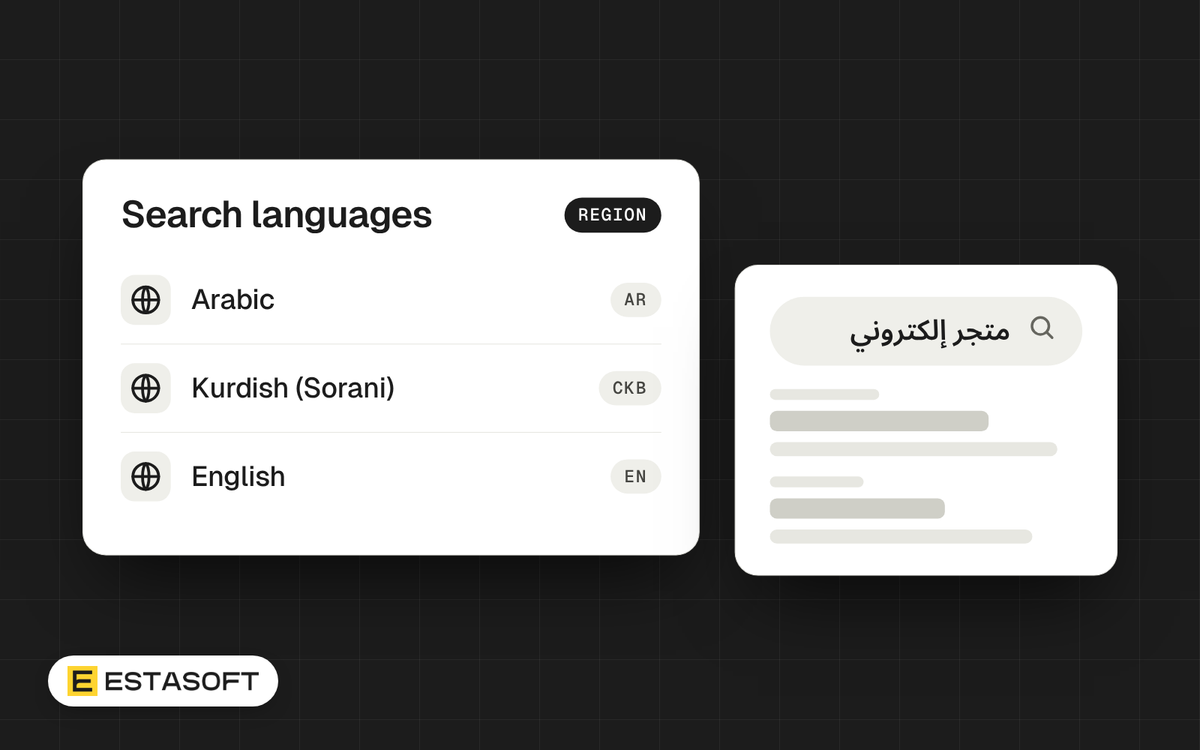
Most company sites here publish in Arabic and English, and some add Kurdish. Google's guidance for multilingual sites gives you the rules:
- Google uses the visible content of a page to decide its language. It does not use the hreflang tag or the HTML lang attribute for that. A page that is half translated confuses the signal, so use one language for the content and the navigation on each page.
- Give each language its own URL. Google recommends this over cookies or browser settings that change the language on the same address.
- Avoid automatic redirects from one language version to another. Googlebot usually crawls from the USA and sends no Accept-Language header, so a redirect based on language or location can stop it from reaching the Arabic pages.
- Google lists four URL structures: a country-specific domain, a subdomain, a subdirectory and URL parameters. It does not recommend parameters. A subdirectory such as /ar/ on your main domain is described as easy to set up and low maintenance on the same host. A country domain gives a strong country signal but targets one country only, and some countries restrict who can register theirs.
Our full setup guide for tags is in Hreflang for Arabic and English sites.
Language codes for Arabic and Kurdish
Google's hreflang page accepts a language code from the ISO 639-1 list, with an optional country code from ISO 3166-1 alpha-2. A language alone is valid, so ar is enough for Arabic everywhere. Add a country, as in ar-AE or ar-IQ, only when you publish a different page for that country, for example with local prices. In the ISO 3166-1 alpha-2 list, AE is the United Arab Emirates and IQ is Iraq. W3C's language tag guidance shows codes for single Arabic varieties, such as afb for Gulf Arabic, but Google's page lists only ISO 639-1 codes, so use ar.
Kurdish needs care. The WordPress translation teams use ckb as the locale code for Kurdish (Sorani). Google's hreflang page does not mention ckb. The two-letter ISO 639-1 code for Kurdish as a whole is ku. Google's page asks for ISO 639-1 codes and ckb has three letters, so ku is the code that fits the format Google states. The documentation does not say how Google treats Sorani pages, so test on your own site, and make sure the Kurdish pages are written fully in Kurdish, because the page text decides the language.
For wording, spelling variants and Modern Standard Arabic against local speech, read Arabic SEO basics.
Use the Google tools that fit the region
Search Console
Create a Domain property. It covers all subdomains and both http and https, and you verify it with a DNS record. The Performance report lets you group data by queries, pages, countries and devices. The default view shows the last three months, and the newest data can still change.
Business Profile
A business is eligible if customers visit a physical location or the business travels to customers. A virtual office with only a mailing address is not eligible. The name must match your real-world name. Google's guidelines also forbid repeating the same name in two scripts or languages, even if your signboard does it, so use one version. More in Local SEO in the Middle East.
Discover
Discover shows content matched to a person's interests. A page can appear if Google has indexed it and it meets the Discover content policies, with no special markup, but eligibility is not a guarantee. Google recommends large images at least 1200 pixels wide, enabled with the max-image-preview:large setting. Its page does not say which countries or languages Discover covers, so check the Discover report in your own Search Console.
What to measure each month
- Clicks and impressions by country (Performance report, Countries tab).
- The top queries in Arabic and in English, shown separately.
- The share of clicks from phones (Devices tab).
- Indexed pages for each language folder (Page indexing report).
- Leads or orders by language, from your own analytics or shop reports.
Look monthly, not daily. No one can promise a position or a visit count, and we do not.
A starting checklist
- Create a Domain property in Search Console and send your sitemap.
- Decide the languages you can maintain well, then give each one its own URL folder.
- Remove automatic language redirects, and add a visible language switcher.
- Add hreflang tags with matching return links on every version.
- Compare ten key pages on a phone and on a desktop.
- Check your Business Profile name against your real-world name.
- Save a first set of Performance report numbers as your baseline.
Mistakes to avoid
- Redirecting visitors by browser language or location.
- Translating only the menu and leaving the main content in English.
- Putting both an Arabic and an English name in the Business Profile name field.
- Using one country's habits for another: Iraq and the UAE differ by about 27 points in mobile share.
- Using a country code alone, or an invented code, in hreflang.
- Planning around Discover traffic, which Google says is not guaranteed.
Questions owners ask
Do I need to optimize for Bing in the Gulf?
StatCounter's September 2026 figures show Bing at about 4% in the UAE and Saudi Arabia, 2.5% in Egypt and 0.16% in Iraq. Start with Google, then look at your own analytics to see whether other engines send visitors.
Should I use ar or ar-AE?
Use ar if one Arabic version serves all countries. Use ar-AE only when you publish a separate page for UAE visitors. Google also suggests a catch-all URL for people who speak that language in places you did not list.
Does a .ae or .iq domain help?
Google says a country domain is a strong signal that a site is meant for that country, but it targets one country only. Ask the registry about its eligibility rules before you buy, because Google notes that some countries restrict who can register theirs.
Need a hand?
If you want a second pair of eyes on your search setup, read about our SEO and growth service, or send a short brief on the contact page.
Sources
- StatCounter Global Stats: Search engine market share in Iraq
- StatCounter Global Stats: Search engine market share in United Arab Emirates
- StatCounter Global Stats: Search engine market share in Saudi Arabia
- StatCounter Global Stats: Search engine market share in Egypt
- StatCounter Global Stats: Desktop vs mobile vs tablet market share in Iraq
- StatCounter Global Stats: Desktop vs mobile vs tablet market share in United Arab Emirates
- StatCounter Global Stats: Desktop vs mobile market share in Saudi Arabia
- StatCounter Global Stats: Desktop vs mobile market share in Egypt
- Google Search Central: Managing multi-regional and multilingual sites
- Google Search Central: Tell Google about localized versions of your page
- Google Search Central: Mobile site and mobile-first indexing best practices
- Google Search Central: Discover and your website
- Google Search Console Help: Add a website property
- Google Search Console Help: Performance report (Search results)
- Google Business Profile Help: Guidelines for representing your business on Google
- W3C: Language tags in HTML and XML
- WordPress Polyglots: Teams, locale ckb
- FAO: List of countries or areas by ISO 2-alpha code
- Wikipedia: List of ISO 639-2 codes (shows the two-letter codes ar and ku)