
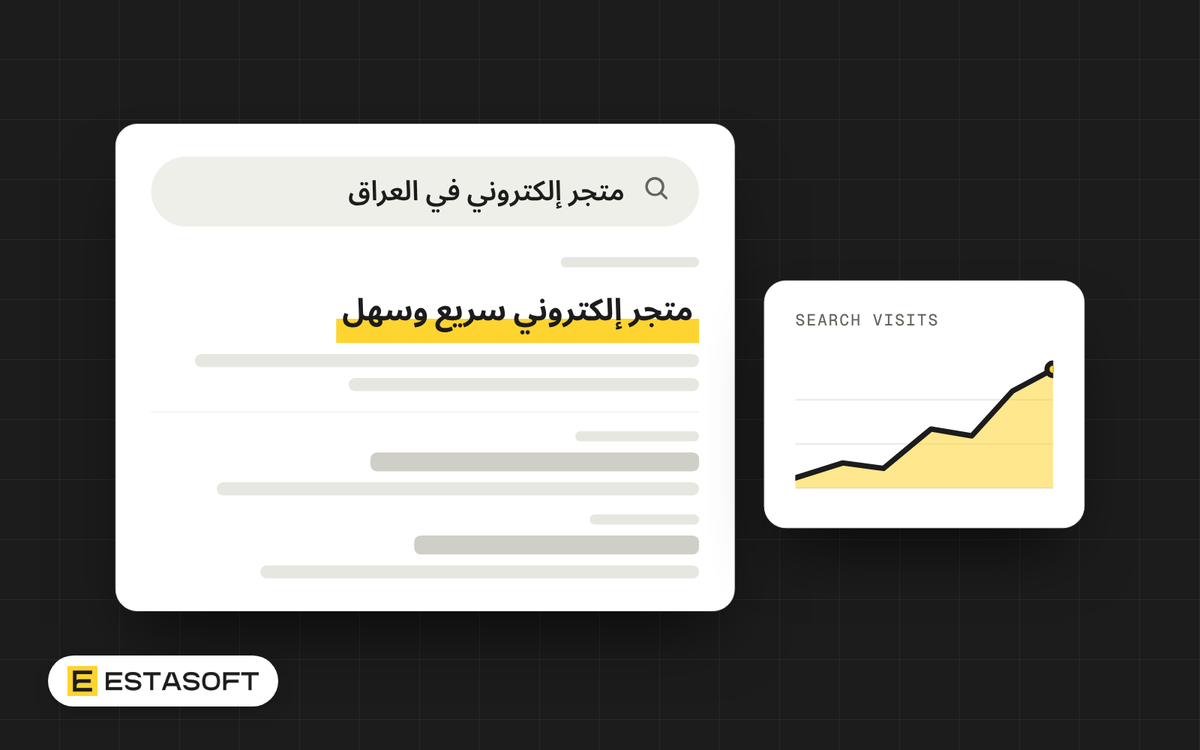
If your customers search in Arabic, your pages need to answer in Arabic, and in the words they actually type. Translating your English pages word for word is not enough. This guide covers the basics that make the biggest difference, for brand owners and company owners who want to be found in Arabic.
1. Start with the words people type
Do keyword research in Arabic, with a native speaker. One idea can be written in several ways, so a list translated from English will miss many of them. Write down three or four ways your customers might ask for your product or service. Then search for each one yourself, on a phone, and look at who appears. Those pages are your real competition.
Look for questions as well as product names. People who are not sure what to buy often search with how, where and which. A page that answers the question can win a visit that a product list cannot.
2. Expect spelling variants
Arabic has letters that people write in more than one way. The same word may be typed with different forms of alef, or with yaa in place of alef maqsura, or with haa in place of taa marbuta. Most people also type without the small marks above and below the letters. Search engines understand much of this, but not everything. Check the most important words in your list in their common spellings, and use the form your customers use in your titles and main text.
3. Modern Standard Arabic or local speech
Modern Standard Arabic is understood across the region and suits most pages, such as company descriptions, guides and policies. For local services and everyday products, customers may search with the words they say in their own country. Test both on the search results page, and write the page in the style that fits your customer and your brand. Do not mix styles on the same page without a reason.
4. People search in two languages
Many customers search in Arabic one day and in English the next, and brand names are often typed in Latin letters. Make sure your brand name appears in both scripts on your key pages. Track Arabic and English results separately so you can see what each language brings.
5. One language per web address
Give each language its own web address, for example a folder for Arabic on your main domain. Then tell search engines which page is the Arabic version of which English page. This is done with hreflang tags. Google asks that every version lists itself and all the others, and the language code can have a region, such as ar for Arabic or ar-AE for Arabic in the United Arab Emirates. If you use Shopify Markets, Shopify creates these tags for you from your market and language setup. You only need to check them. We cover the setup in Arabic and English on one store.
6. Check the page details
- Direction: the Arabic pages must be laid out from right to left.
- Titles and descriptions: write them in Arabic for the Arabic pages. They are the first thing a searcher reads.
- Text in images: search engines cannot reliably read Arabic text that is part of a picture. Keep important words as real text.
- Web addresses: check how your platform builds the address from an Arabic title, and edit it by hand when it is unclear.
- Speed on a phone: Arabic fonts can be heavy. Test the page on a real phone and a normal connection.
7. Measure, and be patient
Use Google Search Console to see which words bring visitors, and from which country and language. Look at it monthly, not daily. Search results take time to move, and no one can promise a position on the first page. What you can control is the quality of the pages and the technical setup.
What to avoid
- Publishing machine translation without a native reader checking it.
- Copying the English page and changing only a few words.
- Repeating a keyword in every sentence. Write for a person first.
If you want help with search in Arabic and English, read about our SEO and growth service, or send a short brief on the contact page.