
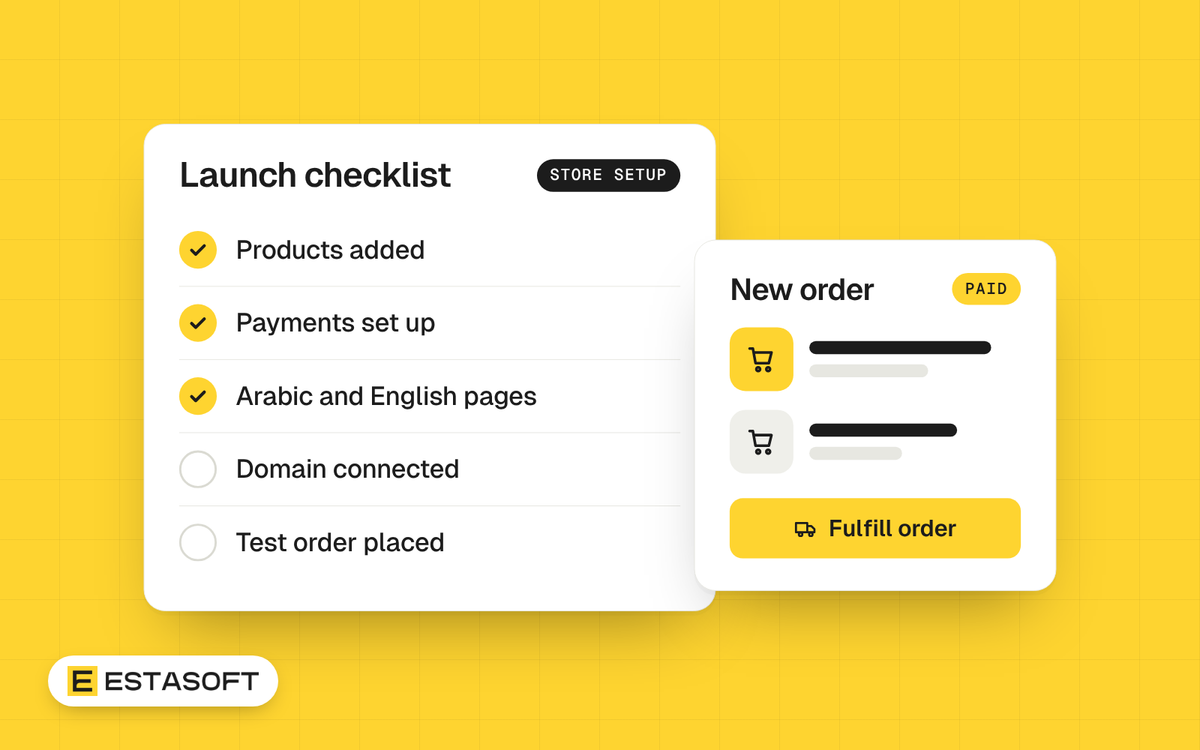
Launching an online store is less about the website and more about the decisions around it: who you sell to, how they pay, how the order reaches them and who answers when something goes wrong. This guide walks through those decisions in the order that saves the most rework. It is written for brand owners and company owners in the Middle East who are starting out or moving online for the first time.
1. Start with one market
Selling in Iraq, the UAE and Saudi Arabia are three different jobs. Payment options, delivery partners, tax rules and customer habits change from country to country, and sometimes from city to city. Pick the market where your customers already are and build for it first. A store set up well for one market can add the next one later without starting again.
2. Choose your languages and currency
Decide early whether the store speaks Arabic, English or both. Arabic is written from right to left, so it changes the layout of the whole store, not only the words. Read Arabic and English on one store before you choose a design. Then choose the currency your customers will see. Prices in the currency people think in build trust.
3. Decide how customers will pay
Payment is where stores in the Middle East differ most from stores in Europe or the US. Cards and wallets are common in some markets. In others, many customers still prefer to pay cash when the order arrives. Payment services also differ by country. At the time of writing, Shopify's list of countries for its own card service, Shopify Payments, includes the United Arab Emirates but not Iraq or Saudi Arabia, so check the current list before you plan. If your store is in Iraq or Kurdistan, read Taking online payments in Iraq and Kurdistan.
4. Plan delivery before design
Write the delivery promise first. The website should only repeat what your team can actually do. Settle these points:
- Which cities and countries you deliver to.
- Who delivers: your own team or a courier.
- What delivery costs: free, a flat rate or a rate by city.
- How long it takes, as a time you can keep.
- What happens with returns and exchanges.
Ask for a phone number at checkout. A courier often needs to call before the parcel arrives.
5. Check tax and legal basics
Tax and registration rules depend on where your business is and where you sell. Ask your accountant what applies before you open, and again before you add a new country. Then put the pages customers look for on the store: contact details, delivery, returns, privacy and terms.
6. Prepare products and content
Good product pages sell. Prepare clear photos in one consistent style, a short description in the language of your customers, sizes or materials where they matter, and honest stock numbers. It is easier to do this before the store is built than after.
7. Choose a platform your team can run
Your team will run the store every day, so it should be simple to edit. We usually recommend Shopify. Your team edits pages in the theme editor without a developer, and Shopify hosts the store for you. Other platforms can be the right choice when there is a clear reason, such as a system you already depend on.
8. Test with real orders
Before launch, place test orders with every payment method and for every delivery area. Check the confirmation emails and the order screen your team will use. Open the store on a real phone, not only on a computer, and go through checkout from start to finish.
9. Launch small, then improve
Open the store to a small group first, such as existing customers or friends of the business. Watch where they stop or ask questions, fix those points, and then start advertising. Most of the improvement comes after launch, from real orders.
Need a hand?
We build Shopify and eCommerce stores for clients in Kurdistan, Iraq, the UAE and the UK. If you want help planning yours, read about our eCommerce solutions or send a short brief on the contact page.