
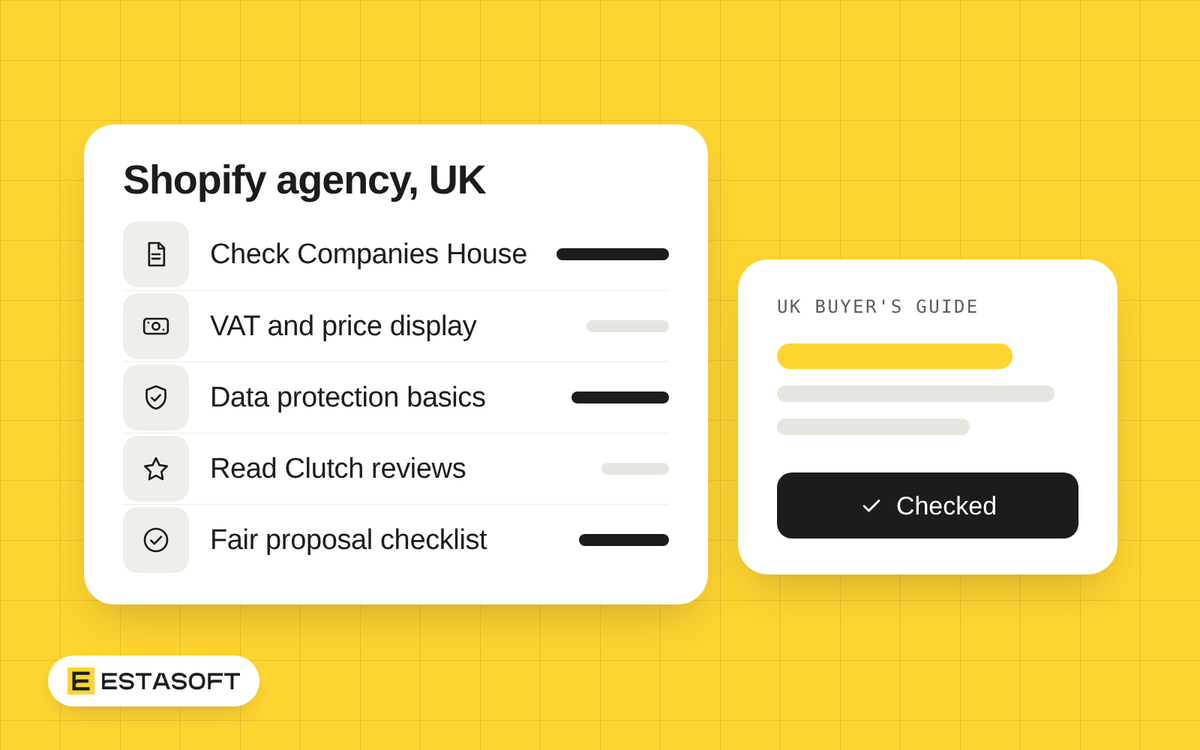
In the UK, local rules touch the store itself: how VAT shows in prices, how you handle customer data and cookies, and how customers can cancel an order. A good agency builds for these from the start. A weak one leaves you to find out later.
This guide helps a UK brand, or a business that sells to UK customers, check an agency before signing. It covers the company check, UK rules that affect the build, Shopify's directory, Clutch reviews and a fair proposal. We read every source on 3 November 2026. For questions that suit any agency, see questions to ask before hiring an agency.
Check that the agency is a real company
Start with the register. GOV.UK says a Companies House record shows the registered name and number, the incorporation date, the registered office, and the company's status, such as live or dissolved. It also shows the officers, the filing history, accounts and annual return filing dates with overdue markers, charges and insolvency details.
- Match the legal name and company number in the proposal, contract and invoice to the register. A trading name is not a legal name.
- Check that the status is live, with no overdue filings.
- Read the list of officers and ask how they are involved in your project.
If the agency charges VAT, ask for its VAT number. The GOV.UK service Check a UK VAT number shows whether a number is valid and the name and address it belongs to. You cannot search it by business name, so get the number from the agency first.
A clean record does not prove good work. If you cannot find the company, ask which legal entity will sign and where it is registered.
VAT and prices: what the build must get right
First, your own VAT position. GOV.UK shows a registration threshold of £90,000 of taxable turnover, and says a business below £88,000 may cancel its registration. There are two tests: turnover over the last 12 months, and expected turnover in the next 30 days. Ask your accountant how they apply to you.
Second, how consumers see prices. The Competition and Markets Authority (CMA) published its price transparency guidance in November 2025 and added a summary on 7 January 2026. The summary says the headline price should normally include unavoidable charges, names VAT as an example, and says showing them separately is not normally enough to comply. Optional extras, such as next-day delivery, need not be in that total if the retailer makes clear that they apply. A CMA open letter to online retailers, published on 2 November 2026, says the total price, including the minimum mandatory delivery charge, must be shown at every stage where a price appears.
In Shopify, the setting that includes tax in product prices and shipping rates sits under Settings, then Taxes and duties. Shopify's help page names the UK as one place that requires tax in displayed prices. Ask the agency to show the product page, cart and checkout on a phone, with VAT and delivery visible at each step.
Data protection and cookies
The Information Commissioner's Office (ICO) says organisations that use personal information must pay a data protection fee, sole traders included, unless exempt. The amount depends on size. Use the ICO's self-assessment tool and take the current amount from its page.
The ICO's UK GDPR basics: have a lawful basis, use data fairly and be open about it. When you collect data, tell people who you are, why you use it, your lawful basis, who receives it, how long you keep it, their rights and their right to complain to the ICO. Cookies and similar technologies fall under the Privacy and Electronic Communications Regulations (PECR). Unless an exception applies, you need consent first, given by a clear action, not a pre-ticked box or continued browsing. Refusing must be as easy as accepting. The ICO finalised its guidance on storage and access technologies, which covers cookies, on 29 April 2026, after the Data (Use and Access) Act changed PECR. It has a chapter on exceptions to the consent rule, so read the current version before launch. See also our privacy and cookies guide for a Shopify store.
Developers who work in your store may be able to see customer data. If an agency will handle personal data for you, ICO guidance says the contract must include the data and its purpose, your instructions, confidentiality, security, sub-contractors, help with breaches and rights requests, and return or deletion of data at the end. Also ask which apps and scripts it plans to add, and what each collects.
Payments, checkout and returns
Shopify's supported countries page says you can use Shopify Payments if your business is in a listed country. The United Kingdom is listed. If your country is not, you need a third-party provider. For UK stores, Shopify's payment methods page lists cards such as Visa, Mastercard and American Express, and the wallets Apple Pay, Google Pay and Shop Pay. It also lists local methods that appear by the customer's location, including Klarna. It does not list PayPal or Clearpay, so if you want either, ask how the agency will add it.
Citizens Advice says a customer who buys online generally has a 14 day cooling-off period that starts the day after the item arrives, then a further 14 days to send it back once they tell the seller. The seller must refund within 14 days of getting the item back or proof of posting, whichever comes first. Exceptions include personalised goods and items that spoil quickly. For more, see our returns and refunds guide. Ask who writes the returns page and who builds and tests the return flow.
Shopify Partners, tiers and the directory
Shopify runs a Partner Directory where you can filter by services, location, industry, language, price range and tier, and sort by rating. Shopify's help page lists four tiers: Select for small and medium businesses, Plus for mid-market and larger ones, Premier for large enterprises and Platinum for global enterprises. Its partner program page says every partner starts on a Registered tier and can move up. The pages we read do not say what earns each tier or whether Shopify verifies partners. That page also says some earlier program brands ended, such as the Shopify Experts Marketplace in December 2023 and the Plus Partner program in December 2024. So ask which tier the agency holds today, and for a link to its directory profile.
Shopify sends review requests once a partner has had collaborator access for a week or more, and says reviews come from eligible merchants on a paid plan. Several recent reviews from stores like yours tell you more than a tier label. If you are weighing a move to Shopify Plus, ask for a Plus project example.
How to read reviews on Clutch
Clutch says reviewers sign in with LinkedIn, Google or a company email, and that each review is checked for identity and work history. If Clutch cannot verify a reviewer but the review is still useful, it publishes it marked Not Verified. Its methodology page, updated October 2026, says reviews carry the most weight in the core of its score, more than clients and experience or market presence, and that only verified reviews count. A directory's default order puts sponsored listings first, then verified providers, then the rest by Clutch rank. So the top of a page can be paid placement. Check which listings are sponsored, then:
- Read recent reviews first. Clutch says reviews from the last two years carry the most weight.
- Look for projects like yours, not a high average alone.
- Read what went wrong and how the agency handled it.
- Check that the people named in reviews would work on your project, and ask for a client you can call.
In the interest of openness: ESTASOFT has an office in London, and this site shows its Clutch 2026 rankings as Top Shopify Company in the United Kingdom and Top International SEO in the United Kingdom. Apply these checks to us too.
What a fair proposal contains
Ask for it in writing. To see what a Shopify project can include, read about Shopify solutions.
- Legal parties: company names and numbers on both sides, and whether the prices include VAT.
- Scope: pages, templates, apps, integrations, languages, markets and migrations, plus a list of what is out of scope.
- Milestones and payments: dated stages, what you receive at each, how you approve it, and payments tied to those stages. See also our guide to fixed price or time and materials.
- Ownership: the store, domain, theme code, design files and app accounts sit with you. Shopify says store owners approve a collaborator request, choose its permissions and can remove access later, and that collaborators cannot receive store ownership.
- Handover: documentation, an admin walkthrough, a list of apps with costs and owners, and removal of the agency's access when the work ends.
- Support: what happens after launch, for how long, how fast the agency responds, and what it bills.
- Data and changes: the processor terms described above, and how extra work is estimated and approved in writing.
Questions to ask
- Which legal entity will sign, and what are its Companies House and VAT numbers?
- Which Shopify Partner tier do you hold today, and where is your directory profile?
- Who will work on my store, and are they employees or contractors?
- Can you show a UK store you built, with VAT and delivery visible at every step on mobile?
- How will you set up cookie consent, and which apps will collect customer data?
- Whose Shopify account will the store, domain and apps sit under?
- How will you test checkout with the payment methods I plan to offer?
- What support do I get after launch, and at what cost?
Red flags
- The agency cannot give a legal name or company number, or the name on the invoice differs from the proposal.
- It asks for your owner login instead of a collaborator request, or wants to create the store under its own account.
- The scope is a few lines with no exclusions, or full payment falls due before any work is shown.
- It promises rankings, traffic or sales.
- Its reviews appear only on its own site, or it will not name a client you can call.
- It waves away questions about VAT display, cookies or ownership, or pushes you to sign quickly.
This is general information, not legal or tax advice. Check the current rules or ask a qualified adviser before you decide.
Next step
ESTASOFT provides Shopify solutions for brands that sell online. To talk about a UK store, read about our Shopify solutions and send a short brief on the contact page.
Sources
- Search the Companies House register: GOV.UK: what a Companies House company record shows (the page's own update date is 9 June 2026) (checked 3 November 2026)
- Check a UK VAT number: GOV.UK: how to check a VAT number and what the service shows (checked 3 November 2026)
- Register for VAT: GOV.UK: the 90,000 pound registration threshold, the two tests and voluntary registration (checked 3 November 2026)
- VAT thresholds: GOV.UK: the registration and deregistration thresholds (checked 3 November 2026)
- Price transparency (CMA209): GOV.UK: CMA price transparency guidance: first published 18 November 2025, summary added 7 January 2026 (checked 3 November 2026)
- Providing clear and accurate information about prices, summary: GOV.UK: headline price to include unavoidable charges such as VAT; showing them separately not normally enough; optional extras can be separate (checked 3 November 2026)
- Open letter to online retailers: including mandatory delivery fees in the total price: GOV.UK: CMA open letter published 2 November 2026: total price, including the minimum mandatory delivery charge, at every stage where a price appears (checked 3 November 2026)
- Include or exclude taxes in prices: Shopify Help Center: the Shopify setting for tax-inclusive prices and the mention of the UK (checked 3 November 2026)
- Data protection fee: ICO: who must pay the fee, sole traders and exemptions (checked 3 November 2026)
- Guide to the data protection fee: ICO: what sets the fee and the self-assessment tool (checked 3 November 2026)
- Lawfulness, fairness and transparency: ICO: the UK GDPR basics: lawful, fair, transparent (checked 3 November 2026)
- What privacy information should we provide?: ICO: what to tell people when you collect their data (checked 3 November 2026)
- What are the PECR rules?: ICO: cookie consent rules: clear action, no pre-ticked boxes or continued browsing, refusing as easily as accepting (checked 3 November 2026)
- Guidance on the use of storage and access technologies: ICO: guidance finalised 29 April 2026 after the Data (Use and Access) Act; chapter on exceptions to the consent rule (checked 3 November 2026)
- What needs to be included in the contract?: ICO: what a controller and processor contract must include (checked 3 November 2026)
- Supported countries for Shopify Payments: Shopify Help Center: Shopify Payments availability and the third-party provider note (checked 3 November 2026)
- Payment methods, Shopify Payments in the United Kingdom: Shopify Help Center: card brands, wallets and local methods for UK stores (checked 3 November 2026)
- Changing your mind about something you've bought: Citizens Advice: the 14 day cancellation right for online purchases and refund timing (checked 3 November 2026)
- Hiring help from the Partner Directory: Shopify Help Center: directory filters, sorting, the four tiers and the review request rules (checked 3 November 2026)
- How the Partner Directory works: Shopify Help Center: tier descriptions; the page does not say what earns a tier or whether partners are verified (checked 3 November 2026)
- About the Shopify Partner Program: Shopify Help Center: Registered tier; end of the Experts brand and Marketplace (December 2023), Plus Partner program (December 2024), Plus Certified App Program and Technology Track tier brands (December 2025) (checked 3 November 2026)
- Collaborator accounts: Shopify Help Center: how store owners approve, limit and remove agency access (checked 3 November 2026)
- How does Clutch verify reviews?: Clutch Help Center: reviewer sign in, identity checks and the Not Verified label (checked 3 November 2026)
- Clutch Research Methodology: Clutch: how the core score is weighted, only verified reviews counting, recency and the default sort order (updated October 2026) (checked 3 November 2026)