
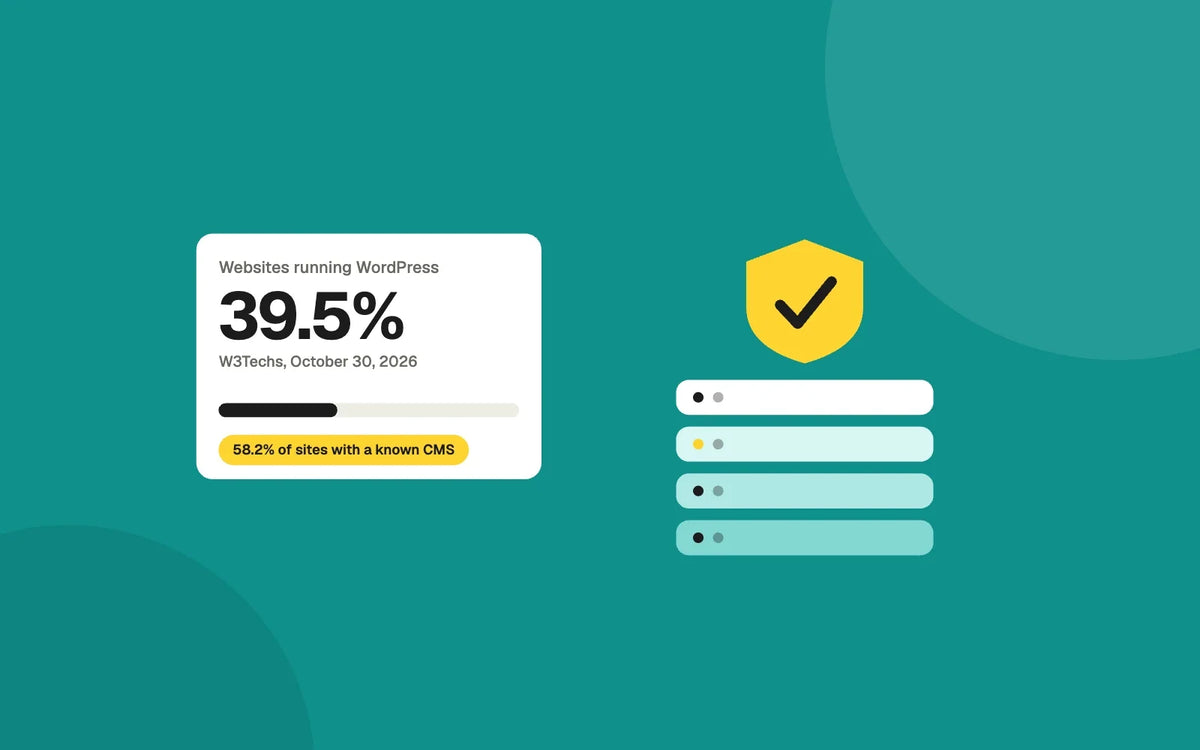
Key number: 39.5%. Share of all websites that run WordPress on October 30, 2026, which is 58.2% of sites with a known content management system (W3Techs).
WordPress VIP is the enterprise hosting and support service sold by Automattic, the company behind WordPress.com. It is often compared with standard managed WordPress hosting, and the comparison is hard to make fairly because most of what is published about VIP comes from VIP. This article separates three kinds of information: independent usage data, the vendor's own technical documentation, and the vendor's marketing claims. It ends with the questions we would put to any enterprise WordPress provider before signing.
WordPress in numbers
The most cited independent measure is W3Techs, which scans the most visited websites and reports what runs them. On October 30, 2026 it showed WordPress on 39.5% of all websites. A further 32.1% use no monitored content management system, which is why WordPress's share is far higher, 58.2%, among the sites where a system could be identified.

| System | Share of all websites | Notes |
|---|---|---|
| WordPress | 39.5% | 58.2% of sites with a known system |
| Shopify | 5.3% | 7.9% of sites with a known system |
| Wix | 4.2% | 6.1% of sites with a known system |
| Squarespace | 2.4% | 3.6% of sites with a known system |
| Joomla | 1.1% | 1.6% of sites with a known system |
| Tilda | 0.8% | 1.2% of sites with a known system |
| Webflow | 0.8% | 1.2% of sites with a known system |
| Duda | 0.7% | 1.1% of sites with a known system |
Drupal and the GoDaddy website builder follow with 0.6% each. WordPress is still by far the largest system, but its lead is narrowing slowly. Among sites with a known system, its share fell from 60.7% on October 1, 2025 to 58.2% at the latest reading, a drop of 2.5 percentage points in a year.
| Date (W3Techs) | WordPress share of sites with a known system |
|---|---|
| October 1, 2025 | 60.7% |
| July 1, 2026 | 59.2% |
| October 1, 2026 | 58.7% |
| Latest reading, October 30 or 31, 2026 | 58.2% |
WordPress.org publishes no usage figure of its own. Its about page says only that WordPress is the platform of choice for millions of sites. WordPress VIP's site says WordPress powers 40% of the web, which is consistent with the W3Techs figure after rounding.
What WordPress VIP is
According to its own site, WordPress VIP is the enterprise content platform built by Automattic, founded in 2006, and trusted by over 700 enterprises. Automattic acquired the analytics company Parse.ly in 2021, and VIP presents it as part of the same offer. All of these are company statements. The page shows no method for the customer count and carries no date.
The practical difference is less about WordPress itself, which is the same open-source software, and more about how a site is built, changed and supported. VIP's documentation describes a managed, controlled path to production that standard hosting plans often leave to the customer.
How the platform works, according to its documentation
- Code lives in GitHub. A GitHub repository in the wpcomvip organization is created for every application. Deployments typically take up to five minutes, and the Dashboard can roll a release back.
- Automated review of code. A Code Analysis Bot checks pull requests, running PHP coding standards, vulnerability, lint and SVG scans. Some pull requests can be approved automatically. The documentation describes automated review only.
- Fewer ways to change a live site. Plugins and themes cannot be added or removed in the WordPress admin area, and there is no SFTP access to the wp-content folder. Changes go through code and review.
- Container-based hosting. The documentation describes container-based infrastructure, 24/7 monitoring and hourly platform backups. The disaster recovery page says four origin data centers are maintained and that hourly database backups are kept for 30 days. It gives no recovery time or recovery point figures. A marketing page cites 28 global data centers, which the documentation does not reconcile with the four origin sites.
- Security attestations. VIP's security page lists FedRAMP Moderate and SOC 2 Type 2. It announced FedRAMP Moderate on April 8, 2025.
- Search and integrations. Enterprise search is built on Elasticsearch and activated in the VIP Dashboard. Integrations are added per organization and then activated per application.
These controls are the product. They suit organizations where several teams touch the same site and where a change to a live page must be reviewed and traceable. They also mean that a site built the usual way, with plugins installed from the admin area, will need rework.
Packages and what they promise
VIP's package definitions page, last modified October 18, 2026, describes three tiers. The pricing page, modified October 27, 2026, publishes no prices and asks visitors to request them. A third-party article put the starting price at $2,000 a month, but we could not confirm it, so we do not rely on it.
| Published term | Standard | Enhanced | Signature |
|---|---|---|---|
| Uptime SLA | 99.95% | 99.99% | 99.99% |
| Urgent ticket response | 60 minutes | 30 minutes | 15 minutes |
| Non-urgent ticket response | 24 hours | 12 hours | 4 hours |
| Network sites | Up to 10 | Up to 100 | Up to 1,000 |
| Real-time collaboration users (pricing page) | Up to 10 | Up to 300 | Up to 300 |
Read the support terms closely. VIP's support documentation says urgent priority is reserved for true emergencies, and that only the Enhanced and Signature packages include code debugging. If your team expects help with custom code on the lowest tier, ask for that in writing.
What customers say, and how much weight it carries
VIP publishes case studies, and they are the main public evidence of how the platform performs. All of them are vendor-published. The index lists 42 studies, including TIME, CNN Brasil, Slate and USA TODAY Co.
- ADWEEK, published March 27, 2025: 100% site uptime during its coverage of the 2025 Super Bowl, with its chief content officer reporting zero issues on the night.
- Pew Research Center, September 29, 2025: the work to make content readable by large language models was cut from six months to one month, and ChatGPT became the site's number two referrer.
- Al Jazeera, August 17, 2021: a headless WordPress build, and the oldest of the case studies we read.
- Election traffic, November 7, 2024: VIP says its platform handled more than 22 billion requests from November 4 to 6 with 100% uptime. No customer is named and the method is not shown.
On analyst recognition, VIP says it is a Strong Performer in The Forrester Wave for content management systems, Q1 2025, and best suited to enterprises and government agencies. We could not open the Forrester report. Forrester's January 30, 2025 preview of a Content Platforms Wave for Q1 2025 names no vendors and says it covers 12, where VIP says 13. The titles differ, so we could not confirm they are the same report. Treat this as a claim until you read the report. VIP's comparison page against WP Engine scores itself for scale, with VIP at 100 million to 1 billion or more users and WP Engine at 10,000 to 100 million. That is a self-scored comparison.
Independent comparisons are mostly by agencies with commercial ties. One that discloses it is a VIP partner argues that a standard managed host, WP Engine, does not require the same rigor of quality assurance. An agency with no disclosed provider ties says standard managed hosting typically offers a 24-hour ticket response, which is the same as VIP's Standard non-urgent term of 24 hours. Neither is a controlled test.
The WordPress project in 2026
An enterprise buyer also depends on the open-source project underneath. The year has been busy.
- Releases. WordPress 6.9 shipped on December 2, 2025, 7.0 on May 20, 2026, after a delay from about April 9, and 7.1 on August 19, 2026. Version 7.0 added an AI Client to core. According to the Gutenberg Times, real-time collaboration was pulled from 7.0 before release.
- Security. Versions 7.1.1 through 7.1.4 were all security releases, on September 17, September 22, October 6 and October 28, 2026. The 7.1.4 release fixed 12 vulnerabilities, including a remote code execution weakness in the upgrade window. On October 21, 2026 a separate critical PHP security release said its flaws affect any server hosting a PHP application and needed no WordPress update.
- Support policy. WordPress's security page says only the latest version is officially supported, with fixes backported to older versions as a courtesy. A managed provider that patches for you has real value here.
- Disputes. WP Engine v. Automattic produced a preliminary injunction on December 10, 2024. On September 28, 2026 the court allowed four antitrust claims and all seven Automattic counterclaims to proceed at least in part. That was a procedural ruling and not a decision on the merits.
- Package distribution. In June 2025 the Linux Foundation announced the FAIR Package Manager, a decentralized alternative to the central WordPress.org plugin and theme ecosystem. WordPress remains licensed under GPLv2 or later and we found no license change.
None of this changes how WordPress performs on a given day. It does bear on risk planning: the project has a heavy release and patch cadence, a legal dispute involving a major host and its steward, and a new effort to distribute plugins outside WordPress.org. A contract should say who handles each of these for you.
What it means for your site
- Start from the change process. If many people edit and release code, code-only deployment, pull request scanning and no admin-area installs may be exactly what you need. If one small team ships changes weekly, they may be friction.
- List your plugins before you talk to any provider. On VIP, plugins arrive through code, so each one needs a plan. Ask which of yours need replacing or custom work.
- Get prices and the support terms in writing. VIP publishes no prices. Compare tiers on response time, code debugging and the network site limit, not on the headline SLA alone.
- Ask for the evidence behind each claim. Request the customer count method, the Forrester report and recovery time and recovery point figures. Ask the provider to explain the difference between four origin data centers and 28 global ones.
- Compare with standard managed hosting on the same checklist. Ask both for response times, deployment method, backup frequency, security attestations and exit terms. Do not accept a vendor-scored comparison.
- Plan for the project's pace. WordPress now ships frequent security releases. Confirm who applies them, how fast, and who tests your plugins against each major version.
- Match the platform to the job. If the site is mostly a store, compare it with a commerce platform before choosing an enterprise content platform. This is our view, not a finding of the sources.
About these numbers
W3Techs measures what it can detect on the most visited websites. Share of all websites and share of sites with a known system are different bases, so name which one you quote.
Everything about VIP's customer count, uptime, request volume, packages and comparisons is the vendor's own statement. Technical details come from its documentation pages, which carry their own update dates.
The Forrester Wave claim was not checked against the report. The price mentioned by a third-party article is unconfirmed and was not used for any conclusion.
Sources
- W3Techs, usage statistics of WordPress. October 30, 2026.
- W3Techs, content management system overview. Shares of all websites, October 30, 2026.
- W3Techs, historical trends in content management systems. Shares of sites with a known system, October 2025 to October 2026.
- WordPress.org, about. Undated.
- WordPress VIP, about. Undated. Vendor claims.
- WordPress VIP, election day uptime. November 7, 2024. Vendor claim.
- WordPress VIP, package definitions. Modified October 18, 2026.
- WordPress VIP, pricing. Modified October 27, 2026.
- WordPress VIP documentation, infrastructure. Updated January 14, 2026.
- WordPress VIP documentation, disaster recovery. Updated September 23, 2024.
- WordPress VIP, the agile content platform. Marketing page citing 28 global data centers.
- WordPress VIP documentation, code deployment. Updated October 16, 2025.
- WordPress VIP documentation, code analysis bot. Updated December 31, 2025.
- WordPress VIP documentation, WordPress on VIP. Updated May 29, 2025.
- WordPress VIP, security. Published June 22, 2026.
- WordPress VIP, FedRAMP Moderate announcement. April 8, 2025.
- WordPress VIP documentation, enterprise search. Updated June 25, 2025.
- WordPress VIP documentation, integrations. Updated July 14, 2025.
- WordPress VIP documentation, support. Updated December 1, 2025.
- WordPress VIP, ADWEEK case study. March 27, 2025. Vendor-published.
- WordPress VIP, Pew Research Center case study. September 29, 2025. Vendor-published.
- WordPress VIP, Al Jazeera case study. August 17, 2021. Vendor-published.
- WordPress VIP, case study index. 42 studies listed.
- WordPress VIP, Forrester Wave post. March 28, 2025. Vendor claim; report not opened.
- Forrester, highlights from The Forrester Wave: Content Platforms, Q1 2025. January 30, 2025.
- WordPress VIP, comparison with WP Engine. November 26, 2024. Self-scored.
- Box UK, WordPress in the enterprise. Modified January 5, 2026. The agency discloses a VIP partner tie.
- Webstacks, best enterprise WordPress hosting for B2B. April 23, 2026.
- WordPress.org, WordPress 7.1.4. October 28, 2026.
- WordPress.org news archive. Release dates for 7.1.1 to 7.2 Beta 1.
- WordPress.org, WordPress 6.9. December 2, 2025.
- WordPress.org, WordPress 7.0 Armstrong. May 20, 2026.
- WordPress.org, WordPress 7.1. August 19, 2026.
- Gutenberg Times, WordPress 7.0 released. May 23, 2026.
- WordPress.org, critical PHP security release. October 21, 2026.
- WordPress.org, security. Undated. Support policy.
- TechRadar, court orders WordPress parent company to stop blocking WP Engine. December 2024.
- Search Engine Journal, Automattic and Mullenweg fail to dismiss WP Engine antitrust claims. September 28, 2026.
- The Register, Linux Foundation and the FAIR Package Manager. June 6, 2025.