
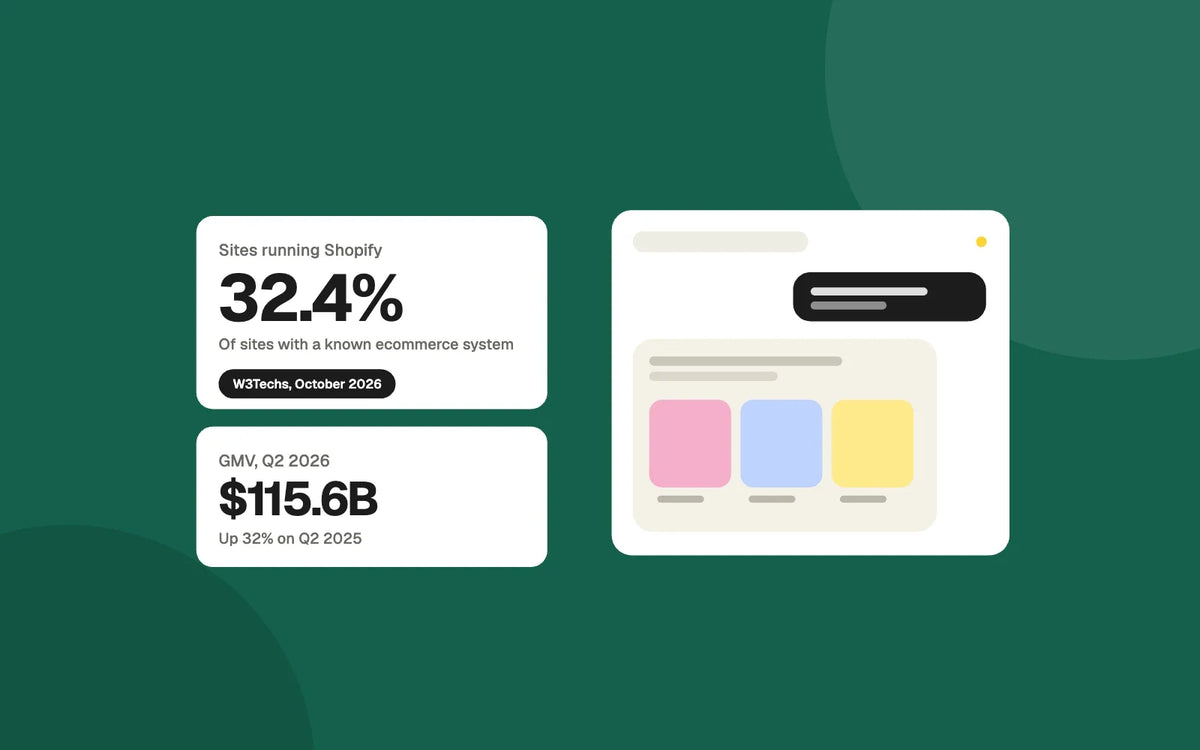
Key number: 32.4%. Share of websites using a known ecommerce system that run Shopify in October 2026, up from 27.9% in October 2025 (W3Techs).
Shopify is easy to describe in slogans and harder to describe in numbers. This article collects what can be checked: how widely the platform is used, how fast its sales volume is growing, what the company released in 2026, how Plus differs from the standard plans and which claims come from Shopify itself and cannot be checked from outside. Where a figure is a company claim, it is labeled as one.
How widely Shopify is used
W3Techs, which scans the most visited websites, gives the cleanest independent view. In its October 31, 2026 snapshot, Shopify runs on 5.3% of all websites. That figure looks small because 83.5% of all websites use no known ecommerce system at all. Among sites that do, Shopify's share is 32.4%, up from 27.9% on October 1, 2025. WooCommerce, which runs inside WordPress, holds 47.4% of the same group, so Shopify is the second largest by this measure, and its share has risen over the last year.
| Measure (W3Techs, October 31, 2026) | Shopify | WooCommerce |
|---|---|---|
| Share of all websites | 5.3% | 7.8% |
| Share of websites using a known ecommerce system | 32.4% | 47.4% |
| Same share one year earlier (October 1, 2025) | 27.9% | Not checked |
Counts of individual stores depend on the tool. StoreLeads estimated 3,189,133 live Shopify stores on October 23, 2026, with the United States at 1,230,214, the United Kingdom at 239,037 and Canada at 148,899. BuiltWith counts 6,772,983 live Shopify websites, with 64,406 of them in the top one million sites by traffic. The two counts differ by roughly a factor of two, and BuiltWith counts websites rather than merchants, so name the tool whenever you quote a number. Shopify's own annual report says only that its merchants number in the millions, and that more than 21,000 apps were available in its App Store on December 31, 2025.
What the quarterly numbers show
Shopify reports gross merchandise volume, or GMV, every quarter. GMV is the total value of orders on the platform. It is not Shopify's revenue. The six most recent quarters, taken from the company's results releases, show a strong seasonal peak in the fourth quarter and growth against the same quarter a year earlier.

| Quarter | GMV, US$ billions | Notes |
|---|---|---|
| Q1 2025 | 74.8 | $74,750 million |
| Q2 2025 | 87.8 | $87,837 million |
| Q3 2025 | 92.0 | $92,013 million |
| Q4 2025 | 123.8 | $123,841 million |
| Q1 2026 | 100.7 | $100,743 million |
| Q2 2026 | 115.6 | $115,567 million, up 32% on Q2 2025 |
For the second quarter of 2026, which ended June 30 and was reported on August 5, Shopify reported revenue of $3,583 million, up 34% (33% in constant currency), and GMV of $115,567 million, up 32%. The four quarters of 2025 add up to $378,441 million, which matches the full-year figure in the company's fourth-quarter release. Shop Pay, the company's accelerated checkout, grew faster than the platform in 2025: Shop Pay GMV rose 62% and gross payments volume rose 37% compared with 2024. The third-quarter 2026 results are due on November 3, 2026, after this article was written.
Checkout: what is measured and what is claimed
Checkout is where a store's traffic becomes revenue, and it is where Shopify makes its boldest claims. They are worth reading with their footnotes.
- Shop Pay reach. Shopify's October 28, 2026 announcement says more than 400 million people trust Shop Pay. Other Shopify pages give 250 million and 150 million shoppers, and the 150 million figure is tied to the Shop app. The counts differ by page, so cite the dated one and treat it as a company figure.
- Shop Pay conversion. Shopify's Shop Pay page says it offers as much as 50% better conversion than guest checkout. The footnote says this is based on an external study completed with a global management consulting firm in April 2023. The firm and the party that paid for the study are not named, so this is a company claim and not independent evidence.
- Independent context. Baymard Institute's list of cart abandonment reasons, updated September 22, 2025, shows that 40% of shoppers who abandoned a cart named extra costs and 18% named a required account. These are the problems that accelerated checkout and clear total costs are meant to address.
One independent measure favors the platform on speed. The HTTP Archive's Web Almanac 2025, published on January 15, 2026, measured how many ecommerce origins pass all three Core Web Vitals, which are Google's thresholds for loading, responsiveness and layout stability. It measures speed, not conversion or cost, and it counts each origin detected as running the platform.

| Platform and device | Origins passing |
|---|---|
| Shopify, mobile (567,932 origins) | 76% |
| Shopify, desktop (289,885 origins) | 76% |
| WooCommerce, mobile | 35% |
| WooCommerce, desktop | 33% |
What Shopify shipped in 2026
Shopify announces product updates twice a year in releases called Editions. Across the three most recent ones, one theme stands out: making stores readable and buyable by AI shopping agents.
- Winter '26 Edition, December 2025. More than 150 updates. It introduced Agentic Storefronts, which let products be sold in AI chat tools such as ChatGPT, Microsoft Copilot and Perplexity. It also added market-specific checkout and expanded Shopify Collective to 35 more countries.
- Spring '26 Edition, June 17, 2026. Shopify says its merchants are enabled for the Universal Commerce Protocol, a standard described as co-developed with Google, by default, and that merchants with eligible products are in its Catalog by default. Catalog access takes an API key with no approval step. Shop Pay became available to brands that are not on Shopify. Managed Markets, which handles duties and taxes for cross-border orders, expanded to the United Kingdom and Canada, and B2B catalogs came to more plans.
- Fall '26 Edition, announced October 28, 2026. Shopify says every store is agent-ready by default, with connectors for nine agents including ChatGPT, Claude, Gemini and Perplexity. It added Universal Checkout on Shop, seven new local payment methods, and Arabic, Hebrew and Urdu storefronts. It also listed Shop Campaigns in more than 35 new markets.
Two of these claims carry numbers that Shopify does not support with a named study. One says data syndicated by Shopify drives twice the conversion in AI chats, and another says international conversion is 50% higher. Treat both as marketing until a method is published. A separate Shopify survey, its 2026 Global Holiday Retail Report, says 65% of shoppers will use AI for at least one shopping task this season, and that only one third say they trusted an AI agent to buy. The sample and method are not shown on the page. Together the two figures say that interest is high and trust is low, which is a reason to prepare data and keep checkout familiar.
One change in the other direction is worth noting for Plus merchants. Shopify said that Shopify Scripts would stop executing on June 30, 2026, with Shopify Functions as the replacement. Stores that relied on Scripts for discounts, shipping or payment logic should have moved that logic by now.
Plans and Plus: what changes at the top
Shopify's pricing page, checked on October 31, 2026, lists the standard plans in US dollars as Basic at $39 a month ($29 on yearly billing), Grow at $105 ($79) and Advanced at $399 ($299). Plus is listed as starting at $2,300 a month. Shopify's Help Center describes Plus as $2,500 a month on a one-year term or $2,300 on a three-year term. Prices change, so confirm them before you plan around them.
| Capability | Advanced | Plus |
|---|---|---|
| Staff accounts | 15 | Unlimited |
| B2B catalogs | 3 | Unlimited |
| Headless storefronts | 1 | 25 |
| Inventory locations | 10 | 200 |
| Online card rate | 2.5% + 30 cents | 2.25% + 30 cents |
| Checkout customization | Standard checkout | Fully customizable checkout |
Plus also supports nine expansion stores, which makes ten stores per contract at no additional cost. Selling in many countries is not a Plus feature, since Shopify's documentation says all plans include an unlimited number of country or region markets. We did not find a Plus merchant count in Shopify's own documents.
What there is no independent evidence for
Merchants often ask whether Shopify costs less to run or is faster to launch than the alternatives. The published answers come from Shopify. A study it commissioned from an unnamed consulting firm, with fieldwork in December 2023 and January 2024, says its total cost of ownership is on average 33% better than that of competitors. A Forrester Total Economic Impact study commissioned by Shopify in March 2024, as described by a trade publication, modeled a composite of partner agencies, not merchants, and found a 155% return over three years. We did not open the Forrester report itself. We found no independent study of merchant total cost or time to launch. Gartner placed Shopify as a Leader in its 2026 Magic Quadrant for Digital Commerce Platforms, according to Shopify, but that report evaluates vendors and does not measure a merchant's cost or conversion.
What it means for your store
- Choose on fit, not on share. A third of ecommerce sites is a large base of themes, apps and agencies. It does not tell you whether the platform suits your catalog, markets and team.
- Measure your own checkout. Compare your conversion and abandonment against the reasons Baymard lists, and test accelerated checkout on your own traffic before you rely on a vendor claim.
- Prepare product data for agents. If AI tools read your catalog, titles, attributes, prices, stock and policies need to be complete and accurate. This is our recommendation, not a Shopify requirement.
- Check the plan against your needs. Staff accounts, B2B catalogs, locations, headless storefronts and checkout customization are the differences that matter at the top. Price them against your own volume.
- Confirm that old customizations still run. If your store used Scripts, verify that Functions or apps now provide the same logic.
- Watch the numbers that arrive next. Third-quarter results are due November 3, 2026. Look at GMV growth, Shop Pay and the effect of the new markets before you change plans.
About these numbers
W3Techs, StoreLeads and BuiltWith are third-party estimates from their own scans and differ in method. Shopify's results are the company's reported figures. Growth rates are as reported, and the quarterly values in the table are exact figures from its releases.
Statements about the Editions, Shop Pay, Catalog, Universal Commerce Protocol, agent readiness and holiday survey come from Shopify's own pages and are not independently verified. Prices were read from Shopify's pages on October 31, 2026.
The Core Web Vitals comparison measures speed only. It does not show that a platform converts better or costs less.
Sources
- W3Techs, usage statistics of e-commerce systems. Snapshot of October 31, 2026.
- W3Techs, historical trends for e-commerce systems. Shopify share from October 1, 2025 to October 29, 2026.
- StoreLeads, Shopify store report. Updated October 23, 2026. Third-party estimate.
- BuiltWith, Shopify usage statistics. Undated. Counts websites, not merchants.
- Shopify Form 10-K for fiscal 2025. App Store size at December 31, 2025.
- Shopify results release, second quarter 2026. August 5, 2026.
- Shopify results release, first quarter 2026. May 5, 2026. Includes first quarter 2025 as the prior year.
- Shopify results release, third quarter 2025. November 4, 2025.
- Shopify results release, fourth quarter and full year 2025. February 11, 2026. Shop Pay GMV and gross payments volume growth.
- Shopify, Fall 26 Edition for merchants. October 28, 2026.
- Shopify, Spring 26 Edition for merchants.
- Shopify, Winter 26 Edition on the developer changelog. December 10, 2025.
- Shopify, Shop Pay. Undated. Conversion claim and footnote.
- Shopify, 2026 Global Holiday Retail Report on agentic shopping. October 6, 2026.
- Shopify developer changelog, Shopify Scripts deprecation. April 9, 2026.
- Shopify pricing. Read October 31, 2026.
- Shopify Help Center, Shopify Plus plan.
- Shopify Help Center, expansion stores.
- HTTP Archive, Web Almanac 2025, Ecommerce. January 15, 2026.
- Baymard Institute, cart abandonment rate statistics. Updated September 22, 2025.
- Ecommerce Fastlane, on the commissioned Forrester Total Economic Impact study. June 3, 2024. Secondary description of a company-commissioned study.
- Finviz, Shopify third quarter 2026 results date. Results due November 3, 2026.
- Shopify, total cost of ownership of ecommerce platforms. Updated March 18, 2024. Company-commissioned.
- Shopify, Gartner Magic Quadrant for Digital Commerce Platforms. Company page, 2026 report.