
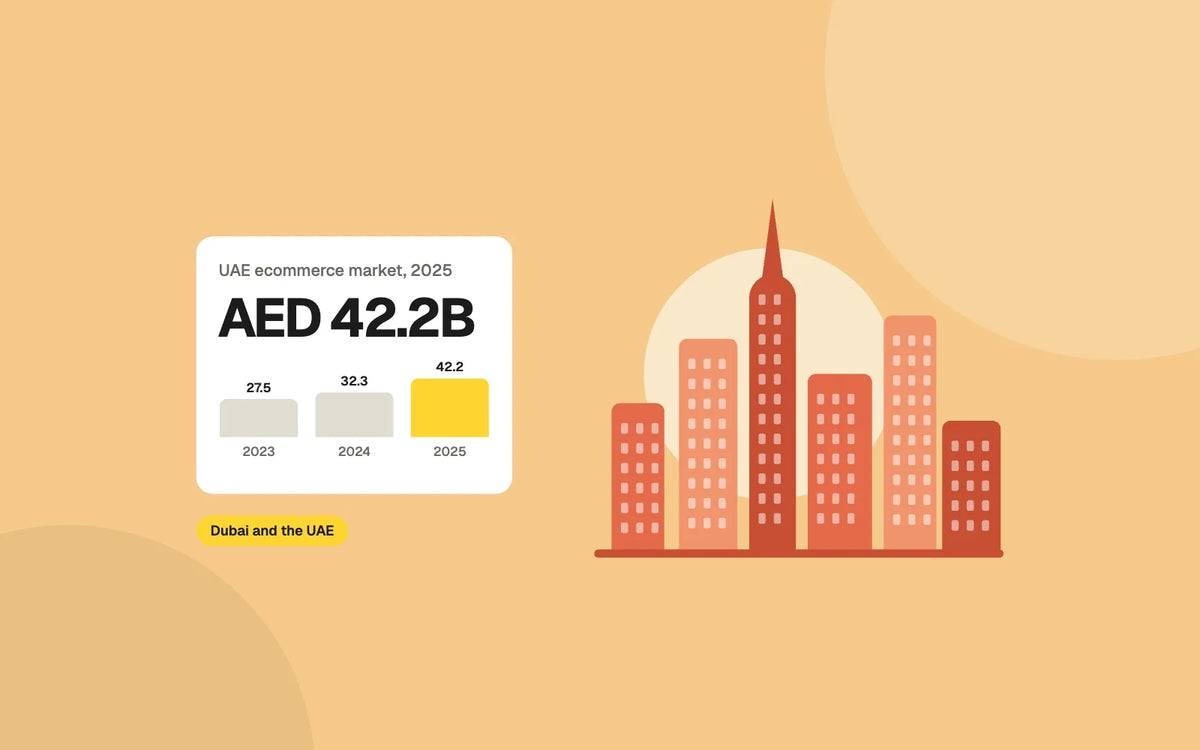
Key number: AED 42.2B. UAE ecommerce market in 2025, about US$11.5 billion and 15.7% of retail sales (Euromonitor, published by EZDubai).
Dubai attracts ecommerce businesses for good reasons: nearly everyone is online, shoppers are used to paying by card and the government has set digital targets. It is also a market where the rules are specific. A store needs the right license, Arabic on its invoices and a delivery promise that matches what shoppers now expect. This article collects the figures that can be traced to a source, notes where sources disagree and lists what we could not verify.
How big the market is
The most cited figure comes from EZDubai, the Dubai logistics hub, which publishes an annual report built on Euromonitor International data. Its sixth report, covered by the press on September 28, 2026, puts UAE ecommerce at AED 42.2 billion, or US$11.5 billion, in 2025. That is about 15.7% of total retail sales, and the report forecasts a share above 20% by 2030. It describes growth of 19% a year over five years from AED 17.6 billion in 2020, and a forecast of 9.9% a year from 2026 to 2030, reaching AED 67.2 billion, or US$18.3 billion.

| Year | AED billions | Notes |
|---|---|---|
| 2020 | 17.6 | Quoted in the sixth report |
| 2023 | 27.5 | Fourth report |
| 2024 | 32.3 | Fifth report. About US$8.8 billion |
| 2025 | 42.2 | Sixth report. 15.7% of retail sales |
| 2028 | 48.8 | Forecast in the fourth report |
| 2029 | 50.6 | Forecast in the fifth report |
| 2030 | 67.2 | Forecast in the sixth report |
Read the chart with care. The figures come from four editions of the same report, and each edition forecasts a different end year. The jump from AED 32.3 billion in 2024 to AED 42.2 billion in 2025 is about 31%, against about 17% the year before, and the release does not explain the difference. The fifth report forecast AED 50.6 billion for 2029, while the sixth reports AED 42.2 billion for 2025 and forecasts AED 67.2 billion for 2030. The estimates move between editions, so quote the edition and year.
Other sources give lower numbers because they define the market differently. An earlier Dubai Chamber forecast, using Euromonitor data, expected US$9.2 billion in 2026, below what is now reported for 2025. Mordor Intelligence, which includes business-to-business sales, estimates US$11.05 billion for 2025 and US$12.30 billion for 2026. The sources do not agree on a single number, and no source we could read explains the gaps.
Who is shopping, and how
- Almost everyone is online. DataReportal's Digital 2026 report counts 11.3 million internet users, 99.0% of the population, at the end of 2025. It also counts mobile connections at 202% of the population. Those are connections, not smartphones.
- Phones lead. The EZDubai and Euromonitor work says more than 75% of purchases in Dubai were completed on smartphones in 2024, and that 70% of people shop online at least monthly. A different measure, from Udora and Admitad data reported by Khaleej Times, puts mobile at 53% for the first half of 2026. The two use different samples and definitions.
- Fewer, larger orders. The same Khaleej Times report says UAE ecommerce orders fell 9% in the first half of 2026 while gross merchandise value rose 2%. The average order value rose from US$97 to US$111, about 14%.
These figures measure different things over different periods, so we do not combine them. Our reading is cautious: the first-half figures point to a market where existing shoppers place fewer, larger orders, which is different from a market adding order volume. That makes repeat purchases and basket size the numbers to watch in your own data.
How shoppers pay
The best source we could open is a 2024 Euromonitor survey of 1,005 respondents in the EZDubai report, in which people could name more than one method. Cards remain the leading choice, and cash is still used by a large majority.

| Method | Share of respondents | Notes |
|---|---|---|
| Credit or debit card | 93% | |
| Cash | 70% | Not split out as cash on delivery |
| Digital wallet | 53% | |
| Bank transfer | 37% |
Digital Commerce 360 summarizes the 53% for wallets as a share of online transactions that rose from 41% in 2020. The report itself counts respondents, so we use that reading. The report also says cash use fell 4% from 2023 to 2024.
Two payment methods that merchants ask about have no verified numbers. We found no trustworthy share for cash on delivery, because the survey does not separate it from cash, and none for buy now, pay later. A payment provider, Checkout.com, reported in a 2022 survey of 15,500 consumers in eight countries that 45% of UAE consumers had used buy now, pay later in the last 12 months, up from 21%. It also said use of the method rose 200% year on year in July and August 2024 across the UAE and Saudi Arabia. Both are provider figures and neither is a share of spending. The most recent UAE-specific Worldpay figure we found is from 2022, when credit cards were 41% of ecommerce transaction value. Worldpay's 2026 global report puts digital wallets at 56% of ecommerce value worldwide.
Licenses, tax and language
This section summarizes official pages and is not legal advice. Check the current requirement with the authority that issues your license before you act.
- A license is required. The UAE government portal says you must have the appropriate license to conduct ecommerce. A mainland license comes from the emirate's economic department, which in Dubai is the Department of Economy and Tourism. All ecommerce licenses need approval from the Telecommunications and Digital Government Regulatory Authority, and free zone companies may need extra approval to sell on the mainland.
- Dubai's options. Dubai's government site lists a mainland trade license, an eTrader license for home-based sole proprietors and a free zone, Dubai CommerCity, which it calls the first dedicated free zone for digital commerce. It says all eTrade licenses require an approval or a no objection certificate. The pages we read list no fees.
- Value added tax. The standard rate is 5%. The Federal Tax Authority sets the mandatory registration threshold at AED 375,000 and the voluntary threshold at AED 187,500. The mandatory threshold does not apply to foreign businesses. Check the exact basis of the threshold with the authority.
- Invoices. The Federal Decree by Law No. 14 of 2023 on Modern Technology-Based Trade requires a clear digital invoice for every transaction.
- Arabic. Under the consumer protection law, Federal Law 15 of 2020 as amended by Decree Law 5 of 2023, an invoice must be in Arabic, and other languages may be added. Ecommerce firms must give product information in Arabic. The law excludes UAE customers who buy from businesses registered abroad.
- Customs. Dubai Customs Notice 16/2026, issued on July 30 and effective August 3, 2026, exempts cross-border business-to-consumer goods up to AED 1,000 from customs duty. Returns within 60 days are also exempt. Read the notice for its exact conditions.
Delivery and returns decide the sale
In DHL's eCommerce Trends Report 2026, based on about 1,000 shoppers per country interviewed from December 15, 2025 to February 11, 2026 and reported by Khaleej Times on October 4, 2026, UAE shoppers put speed and returns first.
| Finding, UAE shoppers (DHL, fieldwork December 2025 to February 2026) | Share |
|---|---|
| Prioritize fast, free delivery and easy returns | 92% |
| Would abandon a cart if their preferred delivery option were missing | 83% |
| Would abandon a cart if their preferred returns option were missing | 81% |
| Mainly have orders delivered to their home | 84% |
| Mainly return items by home collection | 73% |
The EZDubai survey for 2024 found that 33% of respondents prefer 30-minute delivery and 75% prefer delivery based on their location. Amazon.ae announced Amazon Now on October 21, 2025, with 15-minute delivery of everyday essentials and two-hour delivery on thousands of items. We could not verify the traffic or sales share of Noon or Amazon.ae, so we do not state one.
Government targets
Several official strategies shape the market, and it helps to know what they actually say. The Dubai E-Commerce Strategy, approved in September 2019, aimed to add AED 12 billion to Dubai's GDP by 2023 and cut ecommerce business costs by 20%. The official page does not state the outcome. The Dubai Economic Agenda D33 aims to double the size of Dubai's economy over the next decade, with AED 100 billion a year from digital transformation. The Dubai Cashless Strategy, launched on October 9, 2024, targets 90% of transactions as cashless by 2026. We found no published 2026 result, and it is a different measure from the survey above, in which 70% of respondents still use cash for online shopping.
What it means for your store
- Check which market figure you are quoting. The size depends on the source, the year and whether business sales are included. Name the source and edition in any plan.
- Settle the license before the build. Ask the Department of Economy and Tourism, the regulator and any free zone which approvals your model needs, and how long they take.
- Build for Arabic from the start. Invoices must be in Arabic, and product information must be too. Check that your platform supports right-to-left pages and bilingual invoices.
- Offer cards first, then wallets. Cards are the main method in the survey. Add wallets, and decide on cash and buy now, pay later using your own data.
- Show delivery and returns before checkout. Eight in ten shoppers in the DHL survey say a missing preferred option would make them leave. Offer home delivery, home collection for returns and a clear speed.
- Design for the phone, then measure. Most purchases are on smartphones in the survey. Track your own mobile share, order frequency and basket size, since the first-half 2026 data points to larger, less frequent orders.
- Plan for tax and customs. Register for VAT when you reach the threshold, and read the customs notice if you ship from abroad.
About these numbers
Market values come from the EZDubai reports based on Euromonitor International data and are reported as published, including their forecasts. Statista figures could not be read behind its paywall and are not used. The original press release on the state news agency site could not be opened, so republished versions were read.
The payment survey counts respondents who could name more than one method. It is not a share of spending. No verified shares were found for cash on delivery, buy now, pay later or Apple Pay.
Legal and tax points are taken from official pages dated as shown. They summarize requirements and may change. This article does not replace advice from a licensed adviser.
Sources
- Gulf Today, UAE ecommerce market size reaches Dhs42.2 billion in 2025. September 28, 2026. EZDubai report with Euromonitor International.
- TradeArabia, UAE ecommerce expected to grow to $18.3 billion by 2030. September 28, 2026. Share of retail sales.
- HiDubai Focus, UAE ecommerce market size reaches AED 42.2 billion in 2025. September 29, 2026. Growth rates and 2020 value.
- Dubai Media Office, EZDubai launches its fourth report. May 16, 2024. Values for 2023 and the 2028 forecast.
- Digital Commerce 360, report on the Dubai ecommerce market. May 29, 2025. Fifth report values, smartphone and wallet figures.
- EZDubai, E-commerce Report 2025. Undated. Euromonitor survey of 1,005 respondents, payments and delivery preferences.
- Dubai Chamber, UAE ecommerce market forecast to reach $9.2 billion by 2026. Earlier forecast using Euromonitor data. Page date not shown.
- Mordor Intelligence, United Arab Emirates ecommerce market size. Updated July 8, 2026. Includes business-to-business sales.
- Khaleej Times, UAE ecommerce defies regional slowdown as shoppers make fewer but bigger purchases. July 22, 2026. Udora and Admitad data.
- DataReportal, Digital 2026: United Arab Emirates. November 5, 2025.
- Payment Expert, digital wallets in the Worldpay Global Payments Report 2026. April 1, 2026. Global wallet share.
- Worldpay, FIS opens new growth opportunities in the United Arab Emirates. April 26, 2023. Credit card share of ecommerce value in 2022.
- Checkout.com, UAE ecommerce reaches new heights (Arabic page). October 6, 2022. Payment provider survey.
- Checkout.com, summer 2024 sees a boom in digital payments in the UAE and Saudi Arabia. September 12, 2024. Payment provider data.
- UAE government portal, ecommerce. Updated September 28, 2026.
- Dubai government, starting an ecommerce business. Updated April 3, 2026.
- Federal Tax Authority, mandatory registration. Updated May 16, 2024.
- Federal Tax Authority, voluntary registration. Updated May 16, 2024.
- UAE Ministry of Finance, value added tax. Read October 31, 2026. Standard rate of 5%.
- UAE government portal, consumer protection law. Undated. Arabic invoice and product information.
- Dubai Customs, Notice 16/2026. Issued July 30, 2026, effective August 3, 2026.
- Khaleej Times, the UAE ecommerce market is changing fast as consumers spend more. October 4, 2026. DHL eCommerce Trends Report 2026.
- Communicate Online, Amazon gets faster in the UAE with Amazon Now. October 21, 2025.
- UAE government portal, Dubai E-Commerce Strategy. Updated December 30, 2024.
- UAE government portal, Dubai Economic Agenda D33. Updated December 30, 2024.
- Dubai Media Office, Digital Dubai launches the Dubai Cashless Strategy. October 9, 2024.